What Creating Epic Means Inside Nike Now

- May 29, 2026
- Words:
- Portraits:
It’s 2015, and touring Nike’s world campus in Beaverton, Oregon, is Kobe Bryant, 6 foot 6 inches of genius basketball talent, and energetically curious about what his partner sport brand is up to in its product innovation spaces. The creator of Mamba Mentality wanders up to Nike teammates at work and asks, “Are you creating that epic sh*t?”
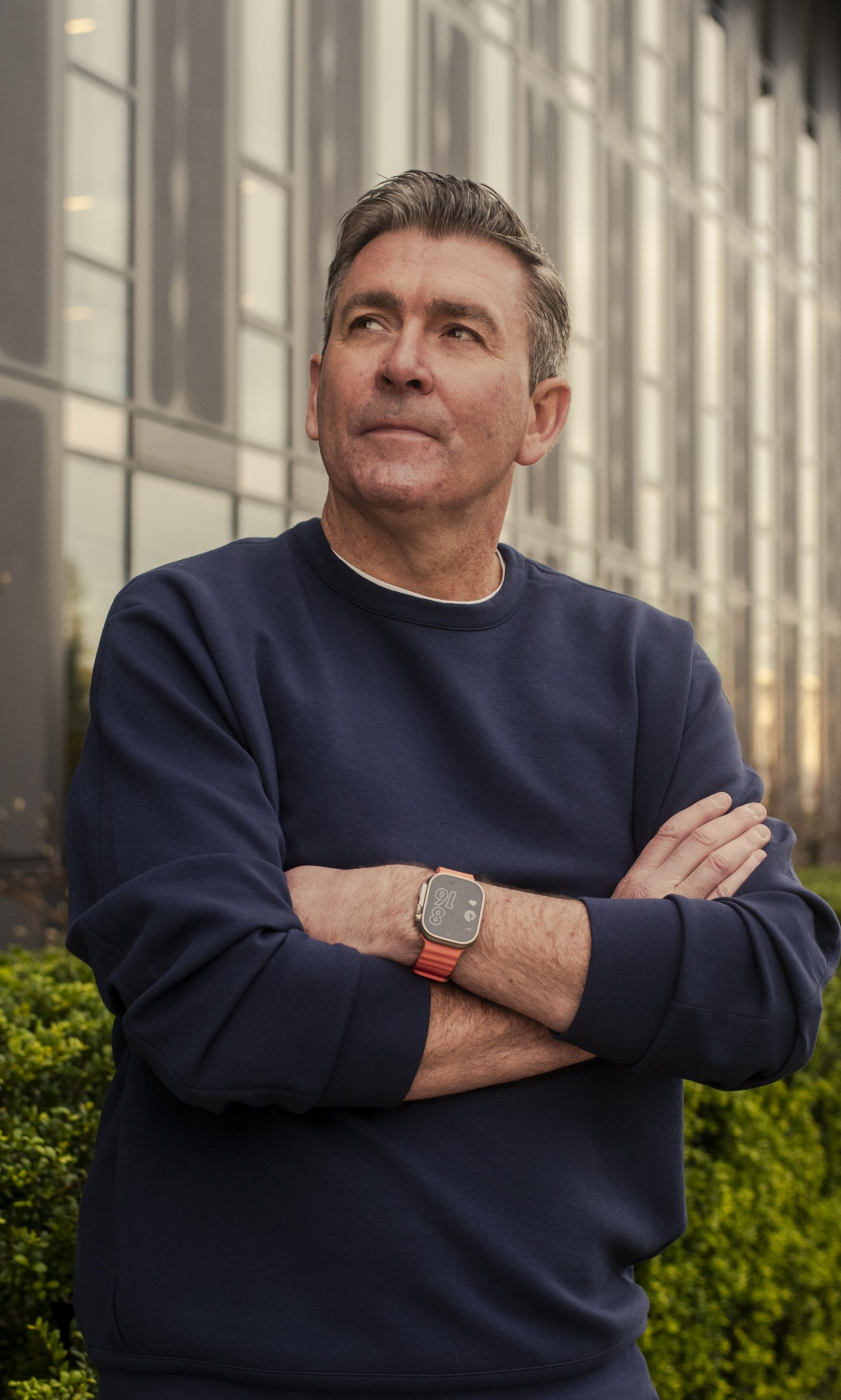
That phrase from Kobe has become the North Star for Nike’s EVP and Chief Innovation, Design and Product Officer, Phil McCartney. It’s a call to action, and it spells out a mission as important to him as Bill Bowerman’s mandate that the company should make athletes* better. “We’ve got the authenticity of Bowerman in the roots of the company, plus the athlete irreverence from Kobe, so put that together and it becomes a standard of excellence,” says McCartney. It’s the way he measures products: Is it epic? Does it make athletes better? “If it doesn’t, then we shouldn’t do it."
“We’ve got the authenticity of Bowerman in the roots of the company, and you’ve got the athlete irreverence from Kobe, so put that together and it becomes a standard of excellence.” Is it epic? Does it make athletes better? “If it doesn’t, then we shouldn’t do it.”
Phil McCartney, EVP, Chief Innovation, Design & Product Officer
Before McCartney came into his role in June 2025, Nike had no shortage of ideas and sport-science research. What it needed was focus, the muscle memory to turn its athlete insights, science-backed data and design and product ideas into intentional, sharper, more epic swings. A little chutzpah couldn’t hurt either. “I wanted us to get our swagger back, to be more responsive, have a competitive spirit and an athlete’s mindset about the work,” says McCartney.
A clear strategy, ruthless prioritization, and license to dream came through in short order. Last September, the Innovation team organized as “IDP” — Innovation, Design, Product — an acronym that McCartney says belies the creation process: Before his team does anything, they have to innovate, then design, and the product is the outcome. At the same time, the company launched its Sport Offense — organizing teams enterprise-wide by sport to better serve the athlete. His two immediate goals in his role: connect product back to science, taking advantage of the company’s ability to scrutinize and study like no one else, and shore it up with the art of athleticism. And build a deeper, holistic approach to innovating that better connects teams across NIKE, Inc., creating one engine that accelerates product creation.
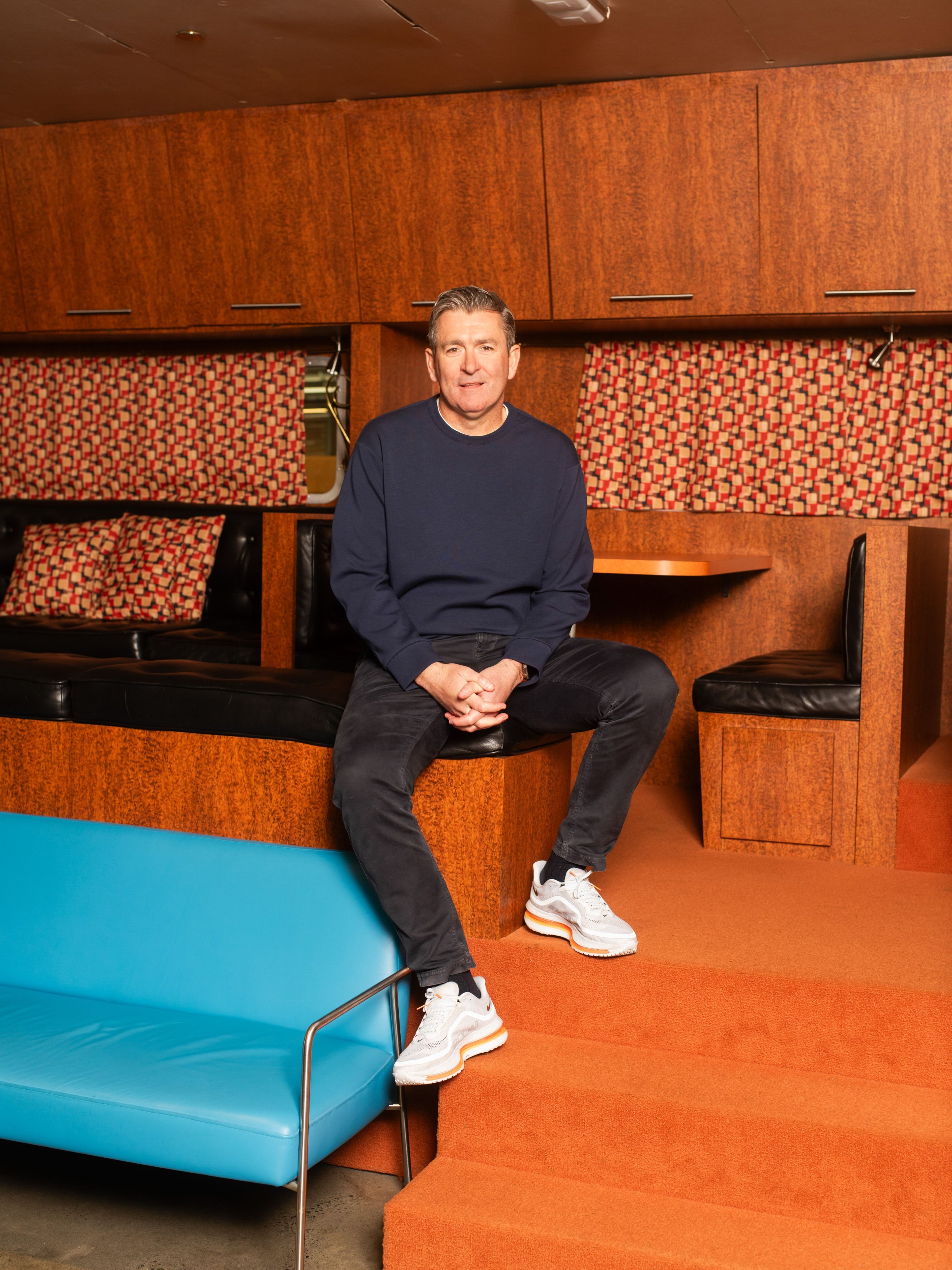
“I want us to go grassroots again, to operate a hyperlocal model and be so connected with the athletes that we can anticipate their next need.”
Phil McCartney, EVP, Chief Innovation, Design & Product Officer
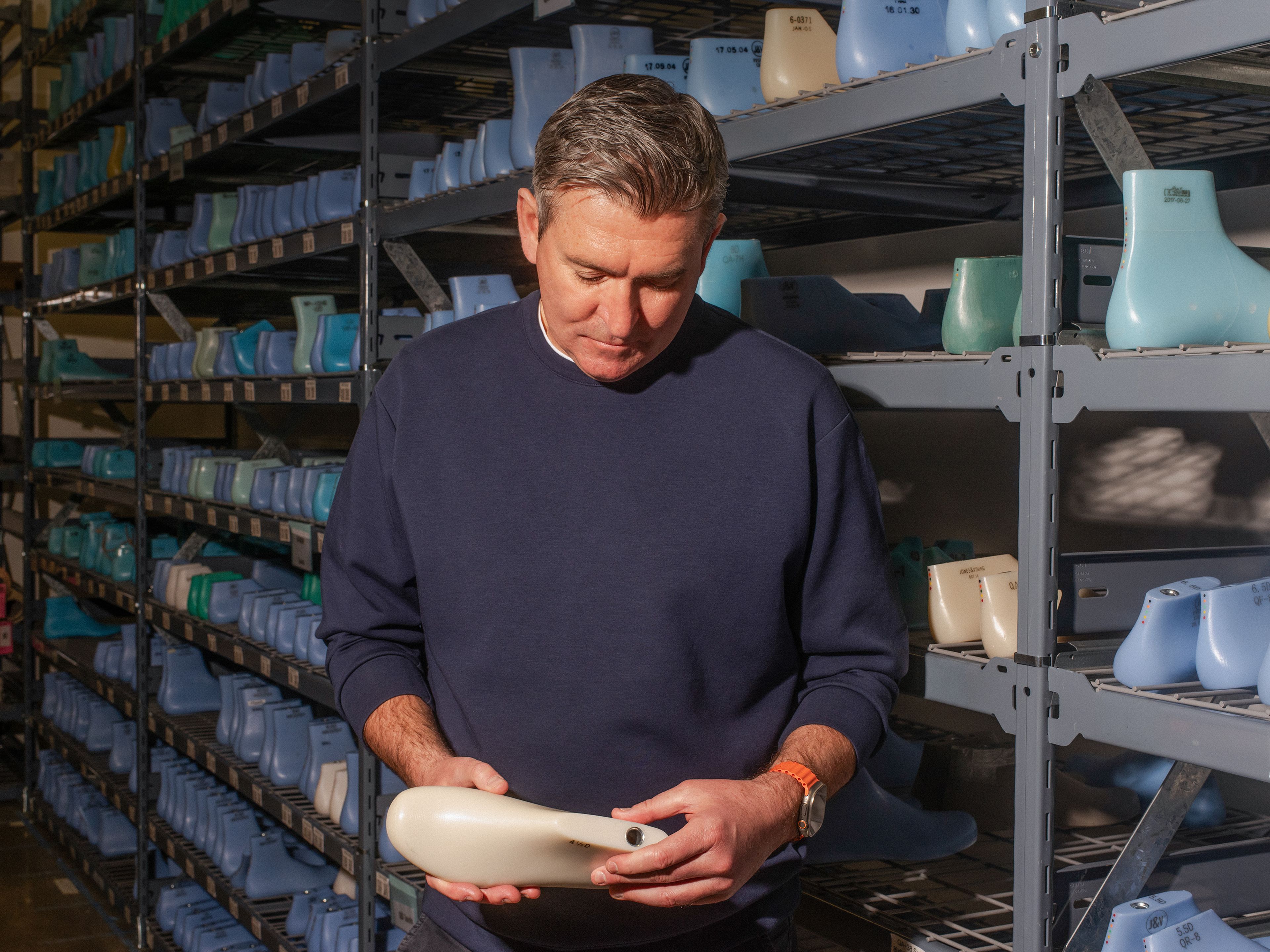
McCartney says he's at his happiest in creative spaces on campus — the Serena Williams Building, the Michael Jordan Building, the LeBron James Innovation Center and Converse spaces, and the Bowerman Footwear Lab, where he says teams create magic every day. This 90,000-square-foot space tucked inside the campus’s Mia Hamm Building is an imagination machine for sneaker creation. Amidst heaps of colorful bolts of fabric and foot lasts, McCartney is like a kid at Disneyland, grinning at the technological abilities at the company’s fingertips. “This footwear lab changes how people think about creating product and designing — it’s our test kitchen,” explains McCartney, emphasizing that this is the space where you’re reminded that Nike is a product company serving athletes through new solutions. One of the most exciting parts of the space to McCartney is its real-time prototyping capabilities and the ability to tinker with a product idea for an athlete visiting campus, then instantly modify the proto based on their feedback.
That innovator’s spirit goes hand and hand with another classic Nike strategy: Get out into the communities and know your people. “I want us to go grassroots again, to operate a hyperlocal model and be so connected with the athletes that we can anticipate their next need,” says McCartney. Sitting in his fifth-floor office in the Sebastian Coe Building, he pulls out his computer and flashes up a deck that goes deep on his innovation teams’ three major product focuses for Nike’s next fiscal year. You can see, he explains, how these three product constructs can be adapted by region, by sport and by athlete. The tight lineup didn’t start this way, he adds. Winnowing down the most innovative products to these three constructs took months of killing good ideas in favor of great ones, then punching those up to be epic.
One step to making this a reality, says McCartney, is to bring key partners along. He’s fresh off a two-week trip to Asia, where he says he worked directly with factory owners he’s known for 20 years. “We walked through the steps to accelerate my teams’ ideas from concept to final product faster and more efficiently,” he says. “This is an essential part of revving our innovation engine and solving challenges in real time.”
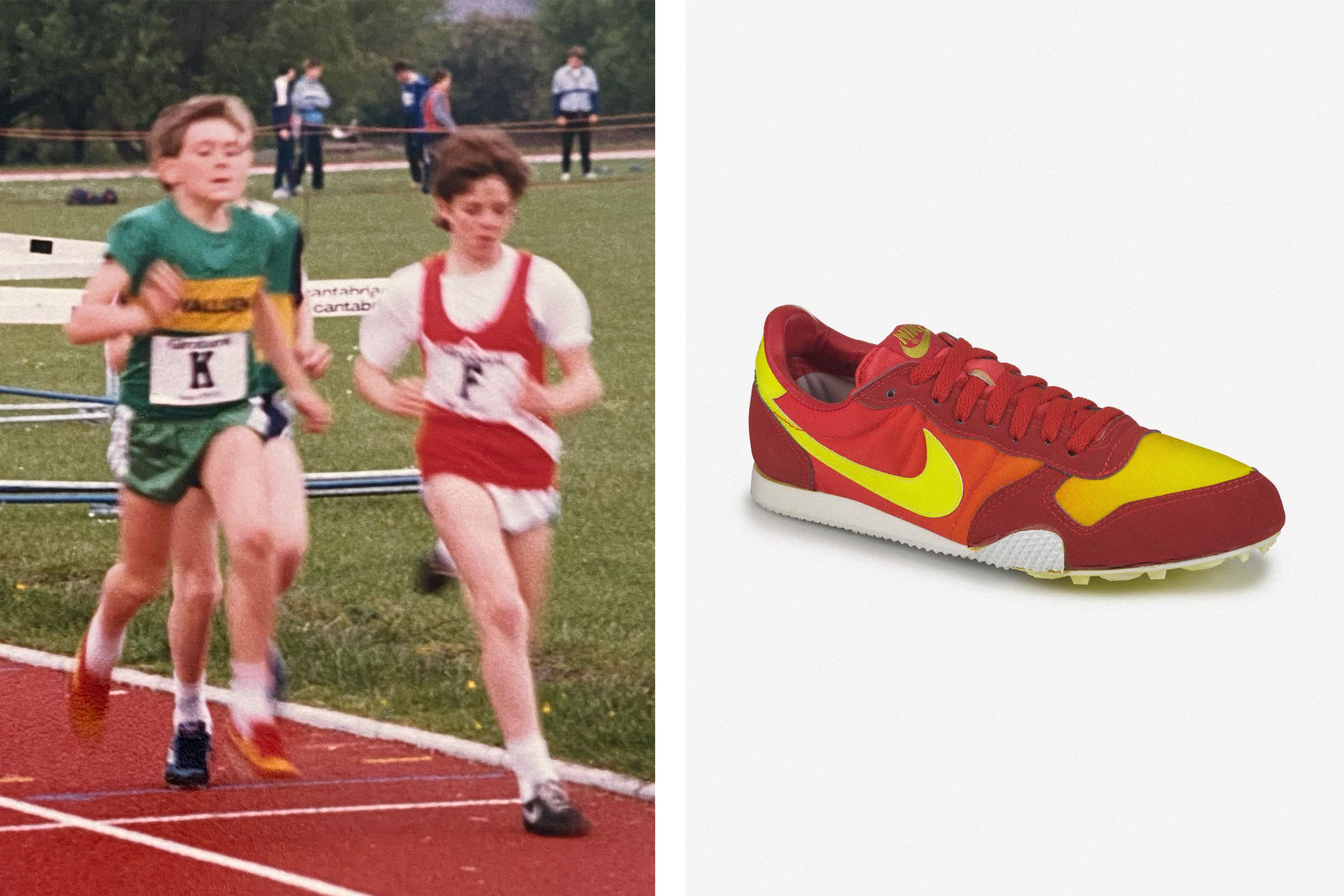
At left, McCartney winning his first track and field race, a 1,500-meter, in his first pair of Nikes; at right, the Nike Flame spikes he wore, which sit in his office today.
Like everyone else he knew growing up, McCartney wanted to be footballer. The sport was the lifeblood of Newcastle, the city in northern England where he was raised. Football was also one of the clearest paths out of the working-class town, a place where most people left high school after 16 to start earning money. College was something that other people did, and opportunities elsewhere, like the U.S., seemed about as close as the moon. So, along with the rest of the boys he knew, McCartney joined his school football team, shoring up dreams of kicking his way into the Premier League.
After his first few uninspiring games, his dad suggested he try something else. This was young Phil’s first lesson in editing and prioritizing, walking away from an okay idea for a better one. McCartney tried a running club, set up by local parents to keep their kids out of trouble. The families operated on a tight budget — his father installed drywall, and his mother worked in youth community building — and the rule within the club was that once you outgrew your trainers, you passed them down to a younger kid. McCartney was soon in possession of a pair of bright orange-red sneakers, replete with a yellow Swoosh as electric as lightening. “Imagine getting that as an 11-year-old kid,” he says. He loved them so much, he slept in them. “I had no idea what Nike was, didn’t know it was American, never even heard of Oregon.” But he knew how the shoes made him feel: invincible, strong, fast, capable. The first race he ever won — a 1,500-meter on the track — was in Nikes.
He punctuates this story by pulling out a pair of those exact Nike Flame spikes on a January morning in Glo’s Cafe at the base of the LeBron James Innovation Building on Nike’s Philip H. Knight Campus. (These aren’t the same shoes he had as a youth, but rather a pair he tracked down later on.) They’re more than just leather and suede: The shoes are a reminder of his duality, who he is and who he’s been, and what has kept him going. The kid who filled his hours doodling sneakers; the teen who started working in retail to help support his family; the young man who applied for his dream job at Nike, becoming a Nike EKIN (because these experts are supposed to know the brand’s products backward and forward); and now, the leader who sets its strategy for innovation, design and product.
McCartney knows persistence, intelligence and hard work brought him to where he is today, but for years, he says, he couldn’t help feelings of imposter syndrome, of thinking he was still that working-class kid from middle-of-nowhere-England pretending to be just as sophisticated as everyone else. To this day, he says, those feelings can creep in on him. “I’m proud of where I’m from, but there is just such a huge gap from where I was to where I am,” says McCartney. That fact makes it all the more important, he adds, to show his teams that they can be their authentic selves. “I want our people of all backgrounds to feel comfortable here,” he says, adding “it’s hard to be creative if you’re trying to be someone else at the same time.”
McCartney credits some of this managerial approach to Vincent Coates, a Senior Director, Footwear Product Development Lead, for Global Football, who taught him that a great leader provides an environment for people to feel empowered. And Coates confirms that McCartney’s earned that: “I’d walk through a brick wall for Phil,” he says, calling him a leader who is as much at home leading an offsite to discuss footwear as he bringing the levity to diffuse the day-to-day pressure — like when he donned an Elvis outfit and sang Suspicious Minds to lighten the team mood (that story is fact-checked and confirmed). Coates says the company’s return to being a player in the global football market came from strategies like McCartney’s insistence on bringing siloed teams together. Before he took the role, Innovation sat separately from the Product and Marketing teams. Now they’re all connected and pulling toward the same focused goals. “Phil’s created a greater team and this culture of belonging, inclusivity and fun,” says Coates. “Yes, we have challenges. But now, because we’re figuring things out together, it’s an enjoyable journey. That’s the impact he has on people — he makes you want to be all in.”
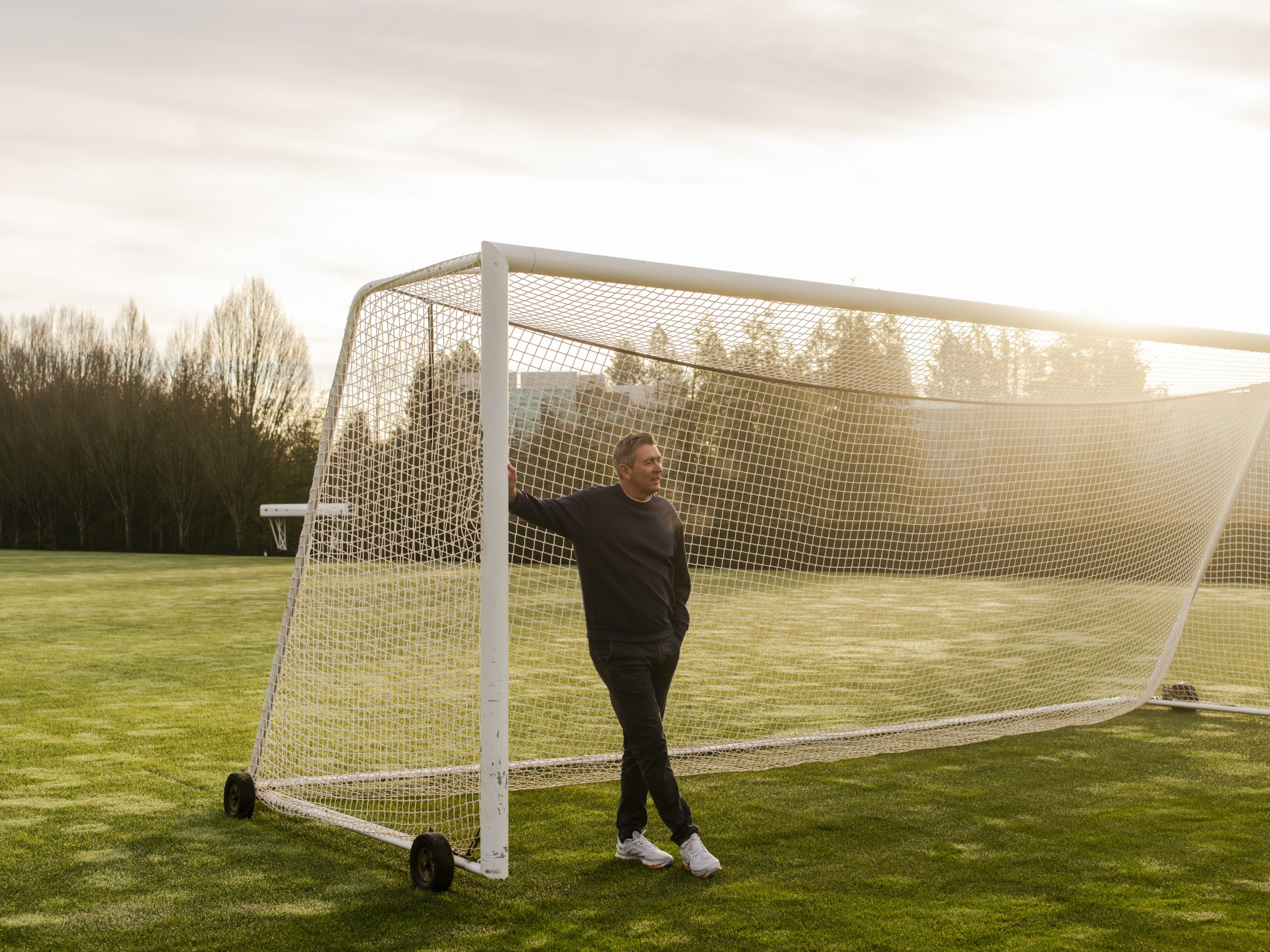
“It’s my job to make sure the company is willing to take the risks, to fearlessly innovate and create the breakthrough products we know we can make.”
Phil McCartney, EVP, Chief Innovation, Design & Product Officer
Since childhood, sport has taken McCartney on some of the pivotal journeys of his life. Races gave him his first taste of exploring different parts of his home country and mixing with different people. With sport, “the world gets bigger and bigger,” he says. And because of his long-held dedication to running, he brings a particular empathy to his work and the plight of the athlete. He knows what it’s like to push yourself beyond what you think you could possibly do, to compete against yourself, to wake up at 5 am for a run, because that’s what he’s trained his mind and body to do. It’s a viewpoint he cherishes in his job, and one that athletes cherish within him. McCartney and legendary marathoner and Nike athlete Eliud Kipchoge have been friends for more than a decade, and the record-breaking runner says that he and McCartney talk about everything: innovation, trail shoes, blisters, their families, the future of the company. Kipchoge loves that they can do that while on a run. “It feels great for me to talk to someone who was an athlete himself, who is working with Nike and is among the decision-makers,” says Kipchoge.
Listening to athletes is not only one of the most inspiring and motivating parts of the job, McCartney says, but a key to making it all work. “The biggest thing in innovation is to take a chance with the athletes and whatever ideas they might have,” he says, citing Breaking2, the 2017 project that ultimately helped Kipchoge complete a marathon in under two hours. “It leads to huge advancements in sport, human potential and technology, and we need those moments just to think differently and bigger."
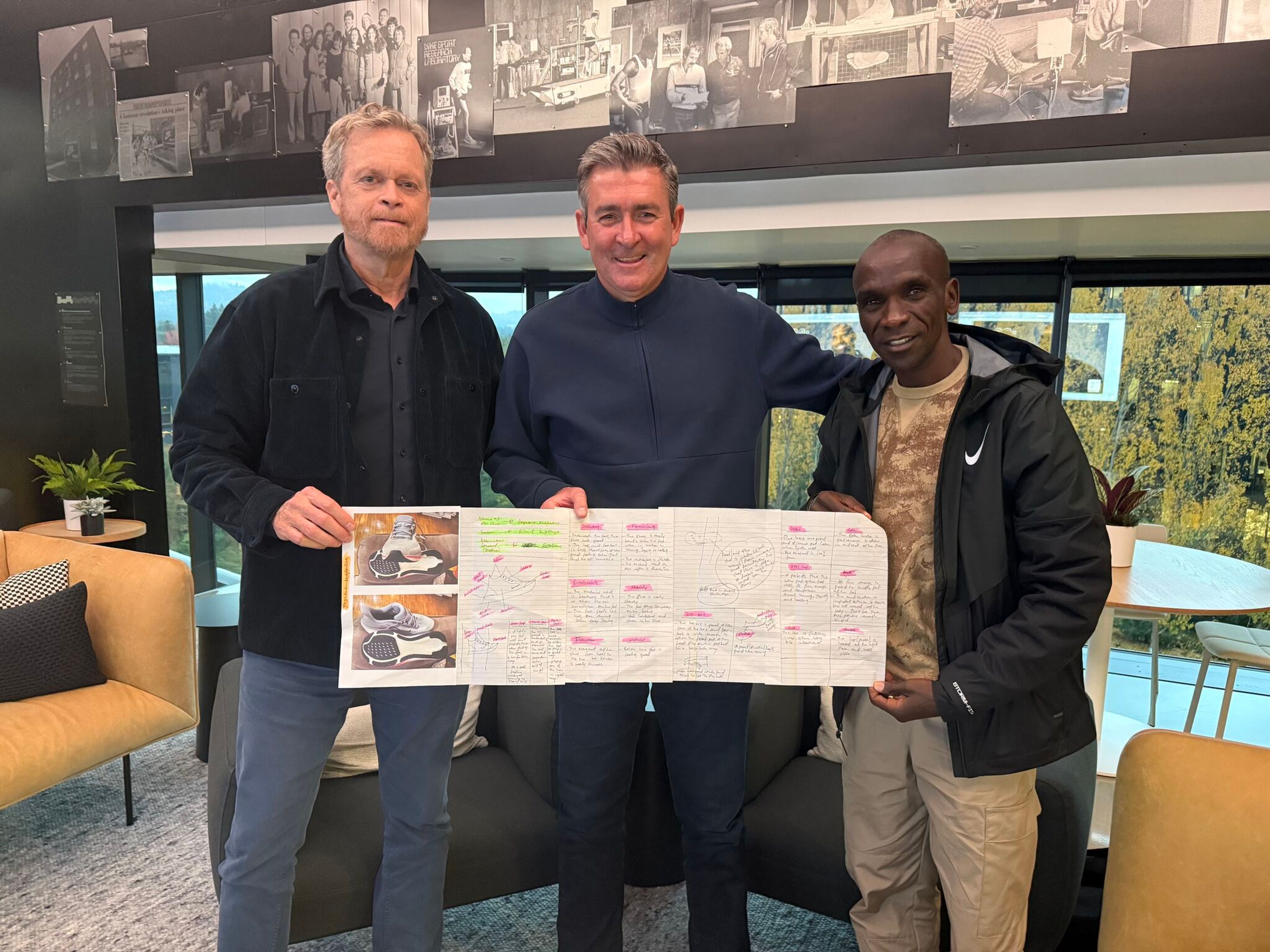
Phil McCartney, center, with Executive Chairman Mark Parker and Nike athlete and champion marathoner Eliud Kipchoge, holding Kipchoge’s hand-written feedback for a Nike prototype racing shoe.
“It feels great for me to talk to someone who was an athlete himself, who is working with Nike and is among the decision-makers.”
Eluid Kipchoge, Nike athlete and world champion marathoner
Like Nike athletes, McCartney wants his team to be bold in their approach to innovation and creativity. He knows, though, that it all starts with him as a leader: “I’m always balancing care with competitiveness,” he says. “We’ve got to win. So how do you create the conditions to do that?” His role isn’t just to execute or delegate; he also wants to create the right conditions for people to do their best work. “We don’t need people to be told what to do; we have loads of incredibly talented people,” he says. “What they need is direction, trust and the air cover to go after something big.”
While McCartney may still be a bit incredulous about leaving Newcastle, when he visits home, he likes to talk to the local kids about his journey: that you can go from being a young runner propelled by the potential in your soles to the executive who guides their production. And not only the sport science that helped create them, but the look, the feeling and the heat that make a new generation of kids wear those shoes to bed at night.
That’s the standard the company’s embracing again under McCartney’s guidance — in the lab, in athlete conversations, in the prototype, in the edit, in the final product. Nothing less than epic sh*t.
*If you have a body, you are an athlete.