The Definitive History of Nike’s World Campus
- May 21, 2026
- Words:
- Present-Day Imagery:
Walk through NIKE, Inc.’s global campus in Beaverton, Oregon, and you’ll experience a place defined by both its scale and the life within it.
This isn’t an office park or even a corporate headquarters. It’s a world. And it’s one built around sport, where movement, the landscape and daily life intersect in ways that feel all-encompassing.
Spanning more than 400 acres, this rolling campus has buildings named for legendary athletes and running paths that wind past soccer fields, a lake and cutting-edge innovation labs dedicated to the future of sport. It’s an intentional, expansive environment.
Last fall, this city within a city, teeming with thousands of employees, was given a new name: the Philip H. Knight Campus, honoring its visionary co-founder whose restless belief in athletes and innovation helped build the company from a fledgling startup into a global force.
But long before this campus existed — before the full-size track, the 11-lane pool and 30-foot-high rock-climbing wall, the hundreds of thousands of square feet of athlete buildings or the world-renowned Nike Sport Research Lab — Nike had no headquarters at all. In 1964, it was known as Blue Ribbon Sports, and it had far humbler surroundings.
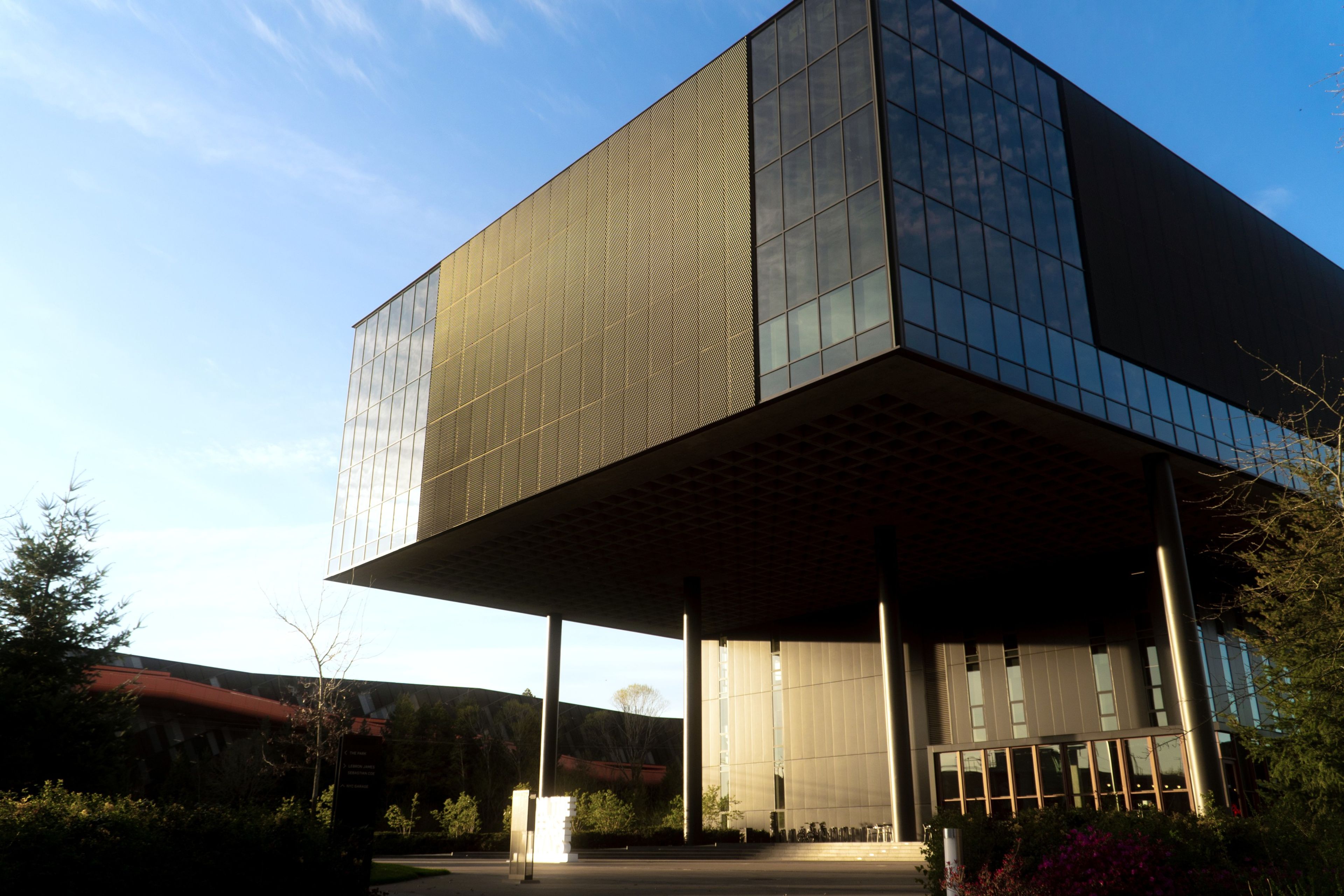
The Lebron James Innovation Center, opened in 2021 with 84,000 square feet of space dedicated to sport research
In April 1964, a shipment of 300 pairs of shoes arrived at the home of Bill and Lota Knight on SE Claybourne in Portland. Their 26-year-old son, Phil Knight — known to friends as “Buck” — was beginning his shoe business, and he stacked the boxes in the basement laundry room.
This space became, quite literally, the company’s first office.
“I don’t remember if I asked them,” Knight later recalled in an interview with the Department of Nike Archives. “I just moved the shoes in.”

The first Blue Ribbon Sports office opened in 1967 at SE 50th and Powell Boulevard in Portland.
“[Our first office] was cheap. Cheap and available.”
Phil Knight, NIKE, Inc. Co-founder
From there, Knight would load the shoes into his Plymouth Valiant and drive to high schools around Portland, trying to sell them directly to runners. Sometimes the athletes didn’t have cash on hand, so they would come by the house later to buy a pair.
“It was pretty amazing that they could find their way,” says Knight. “We were on a one-block street that was hard to find.”
As Knight’s shoe company, Blue Ribbon Sports, grew, it decamped from his parents’ basement, but stability was still years away.
The first official office opened in 1967 at a small building at SE 50th and Powell Boulevard in Portland. Rent was only $50 a month.
“It was cheap,” says Knight. “Cheap and available.”
Inside, the tiny space served as nearly everything at once: home office, warehouse, sales office and retail store. Orders were packed in the back, invoices typed at the front desk, and shipments mailed out by hand.
“We’d get an order and go back and pack the shoes in a box,” recalled Bob Woodell, an early employee and the company’s first chief operating officer. “Then we’d come up front and type up the invoice, address and stamp the envelope, and mail it out. Those were the days when if you could get a 10-pair order, you’d be in heaven.”
It wasn’t exactly a quiet office space. At exactly 4 p.m., the jukebox next door at the Pink Bucket Tavern would kick on, its bass vibrating through the wall.
“You could set your watch by it,” recalled Woodell. “Boom, boom. You’d know it was 4 o’clock.”
The Powell office was the first stop in what became a nomadic stretch for the young footwear company.
During the next decade, Blue Ribbon Sports moved repeatedly — from its first offices in southeast Portland to Tigard’s Horace Mann building then to Beaverton and back to Tigard, near Nimbus Drive, before returning to Beaverton, where the company operated out of a pair of offices on Murray Boulevard known internally as “Murray I” and “Murray II.” Along the way, it also established its first dedicated product warehouse on Burnside in Portland, separate from its office spaces. By this point, it had claimed its permanent moniker — Nike, after the Greek goddess of victory.
By the early 1980s, Nike employees were scattered across more than 20 buildings throughout the Portland area. The company was growing rapidly, but it didn’t yet have a true home base.
Nike knew it needed to bring everyone together in one location.
“We were spread out in buildings all over Washington County,” says Knight. “When we could move to a central place, we felt we could improve communications between the various departments.”
There was also a perception problem. The company was gaining momentum as a major global business, but it didn’t yet look like one.
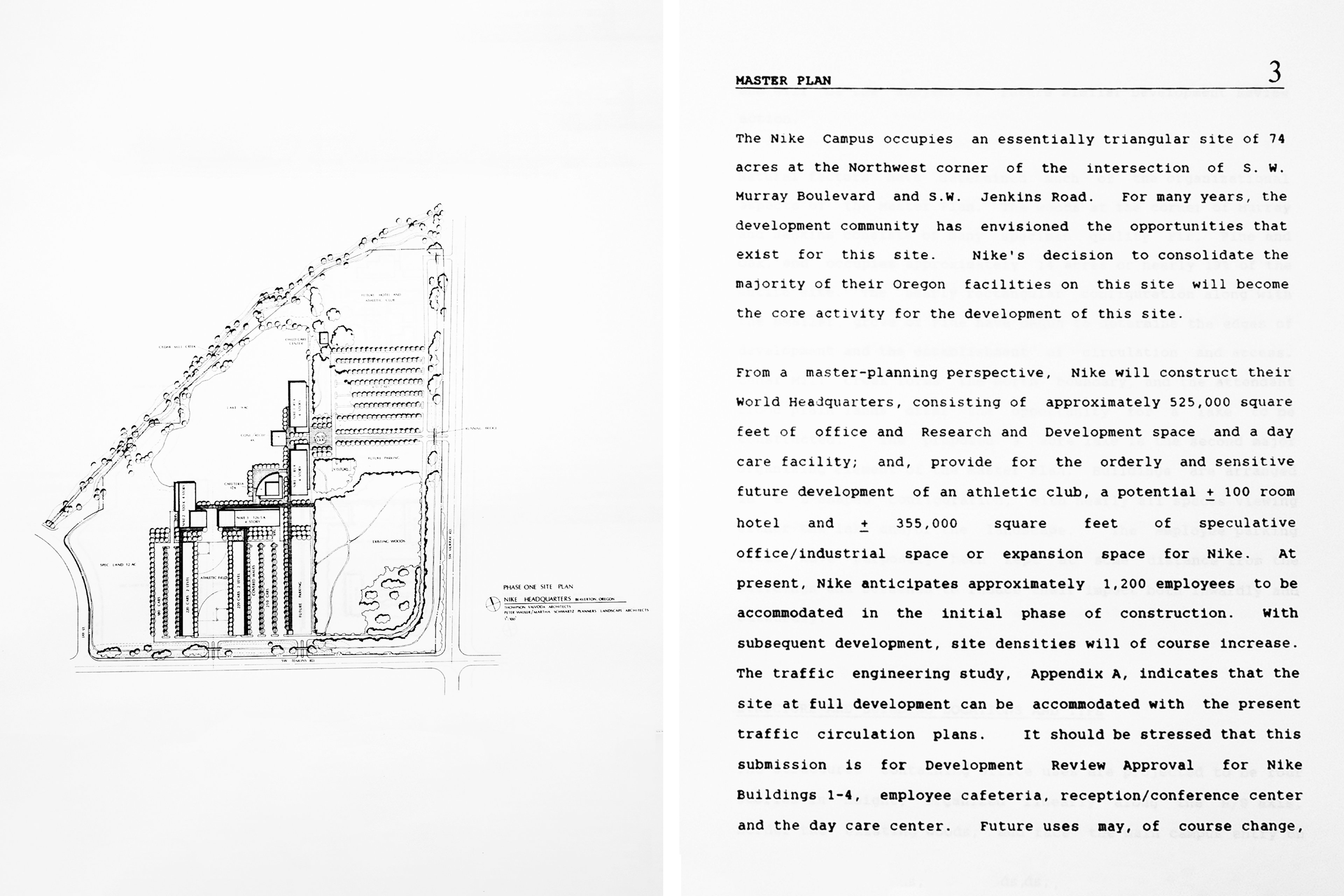
A look at one of the original Nike site plans.
“[We] had some traction, but we had no presence,” recalled Jim Robison, who joined the company in 1979 and later helped lead the campus project. “People were flying in from Asia and Europe, and they’d come to a little 40,000-square-foot building across the street from K-Mart. Then they’d have to get back in the car and go someplace else for a meeting, have the meeting, then get back in the car and go back.”
Nike needed more than space. It needed an environment that reflected what it was becoming.
“We wanted a campus atmosphere because everybody is a junior in college at heart. We wanted a place where you could get your work done, but also a place you wanted to be.”
Phil Knight, NIKE, Inc. Co-founder
In 1984, the company found that physical grounding in a 75-acre parcel just north of its existing offices in Beaverton. Nike purchased the land for $5.5 million in cash, securing the footprint for what would eventually become its permanent world campus.
But construction didn’t begin right away.
“We decided we didn’t want to move on building the headquarters until we really understood what our brand stood for,” says Knight.
That clarity came in 1987, when Nike sharpened its core identity.
“By 1987, we said we were going to be a performance company,” says Knight. “We were going back to our roots — that was our focus.”
With that came a bigger question: If Nike was becoming a global company, what should its world headquarters look like?
When construction began, the goal wasn’t just to bring people together. It was to create a place that felt fundamentally different from the offices it had outgrown.
“We wanted a campus atmosphere because everybody is a junior in college at heart,” says Knight. “We wanted a place where you could get your work done, but also a place you wanted to be.” That idea became the foundation for everything that followed.
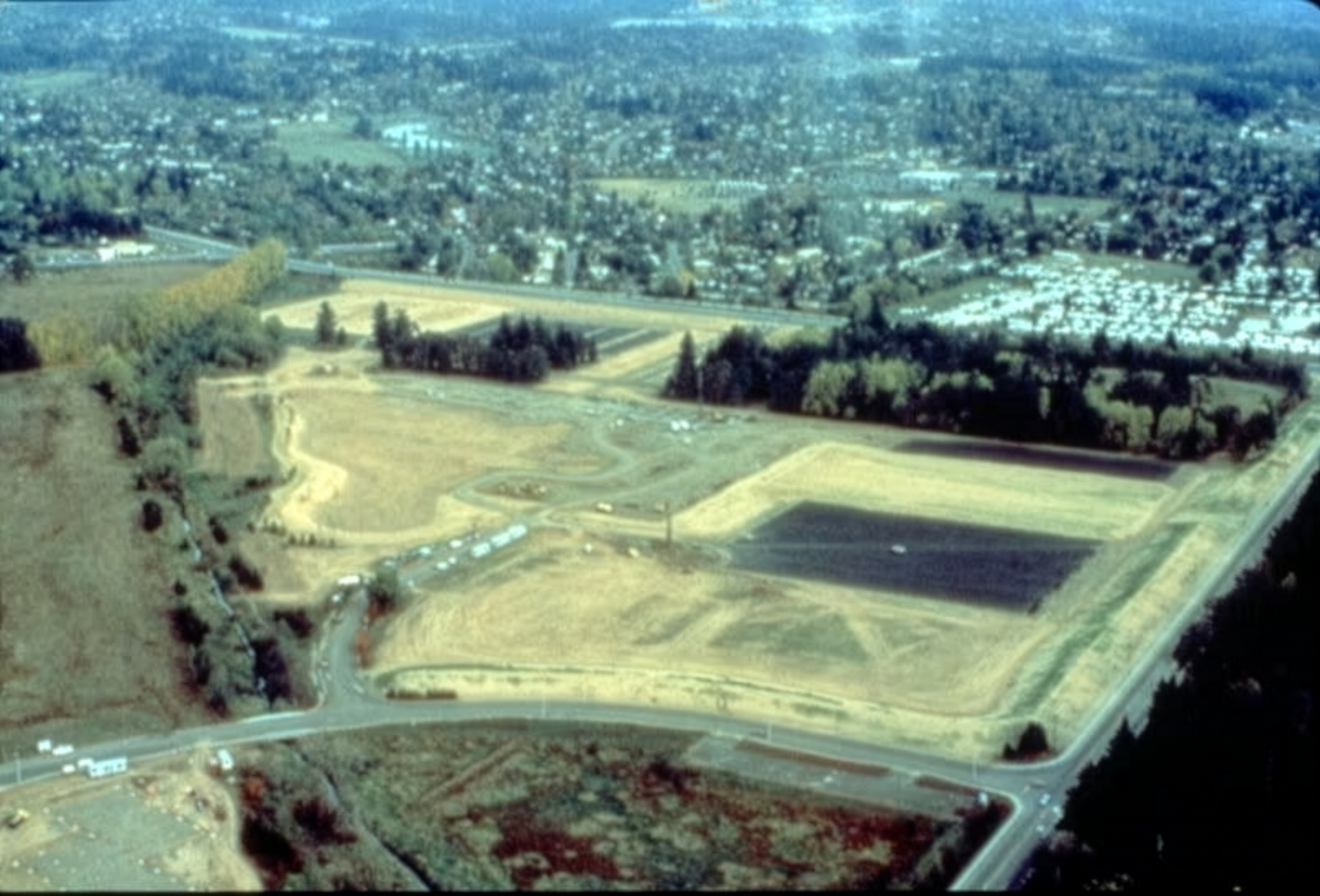
In 1988, construction was underway for Nike’s world headquarters.
Rather than a single high-rise, the new headquarters would take shape as a collection of buildings organized around shared spaces, more like a college quad than a corporate office park. There would be room to move, gather and think.
Early buildings were designed with places to eat, meet and reset. The Joan Benoit Samuelson Building, for example, functioned similarly to a student union, with a cafeteria, small shops and informal gathering spaces that drew employees together throughout the day. Weekly gatherings like the “Thirst Thursday” summer beer garden brought together employees across roles and tenures in a way that blurred the lines between departments.

An aerial shot of Nike’s world headquarters in 1989.
“Everyone from rookie hires to senior executives bumped elbows and lifted pints together,” recalls Nike historian Scott Reames. “It was a relaxed atmosphere that encouraged employees to let off a little steam and also meet Nike colleagues from across every department.”
Nearby, the Bo Jackson Fitness Center served as a campus recreation space, with workout facilities and fields that hosted intramural sports.
“Employees would be surrounded by each other all day, every workday — in their offices, at lunch, at the gym and on the jogging trails. This proximity promoted spontaneous interactions, facilitated collaboration, and fostered a sense of community,” says Reames.
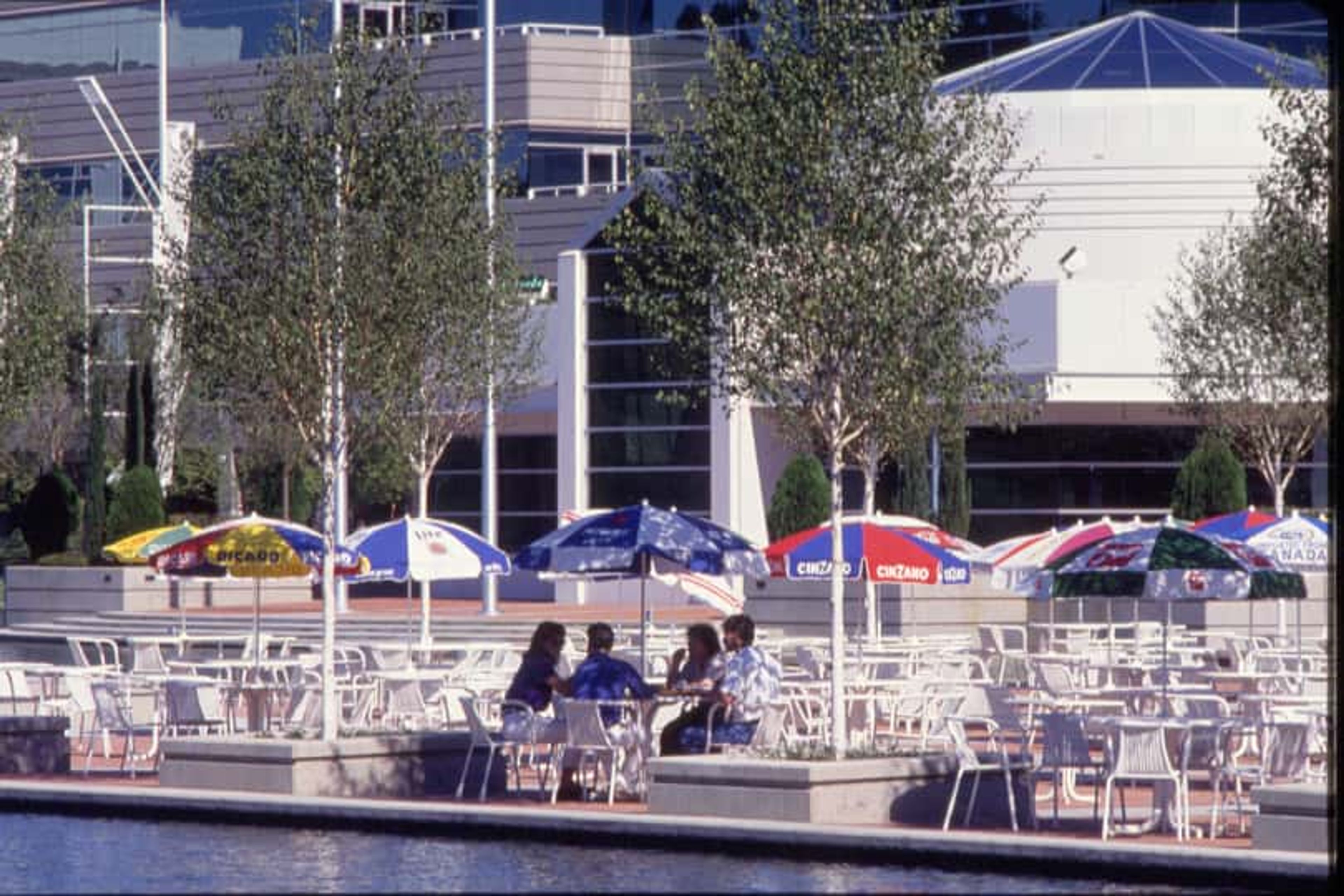
The Joan Benoit Samuelson Building patio, circa 1990.
Nature wouldn’t be pushed away or relegated to an afterthought. It was central to the campus design.
At the heart of the grounds, a manmade lake was introduced, with buildings arranged carefully around it. Rather than treating water and landscape as obstacles, the team chose to build with them, shaping the campus around the environment rather than forcing the environment to conform.
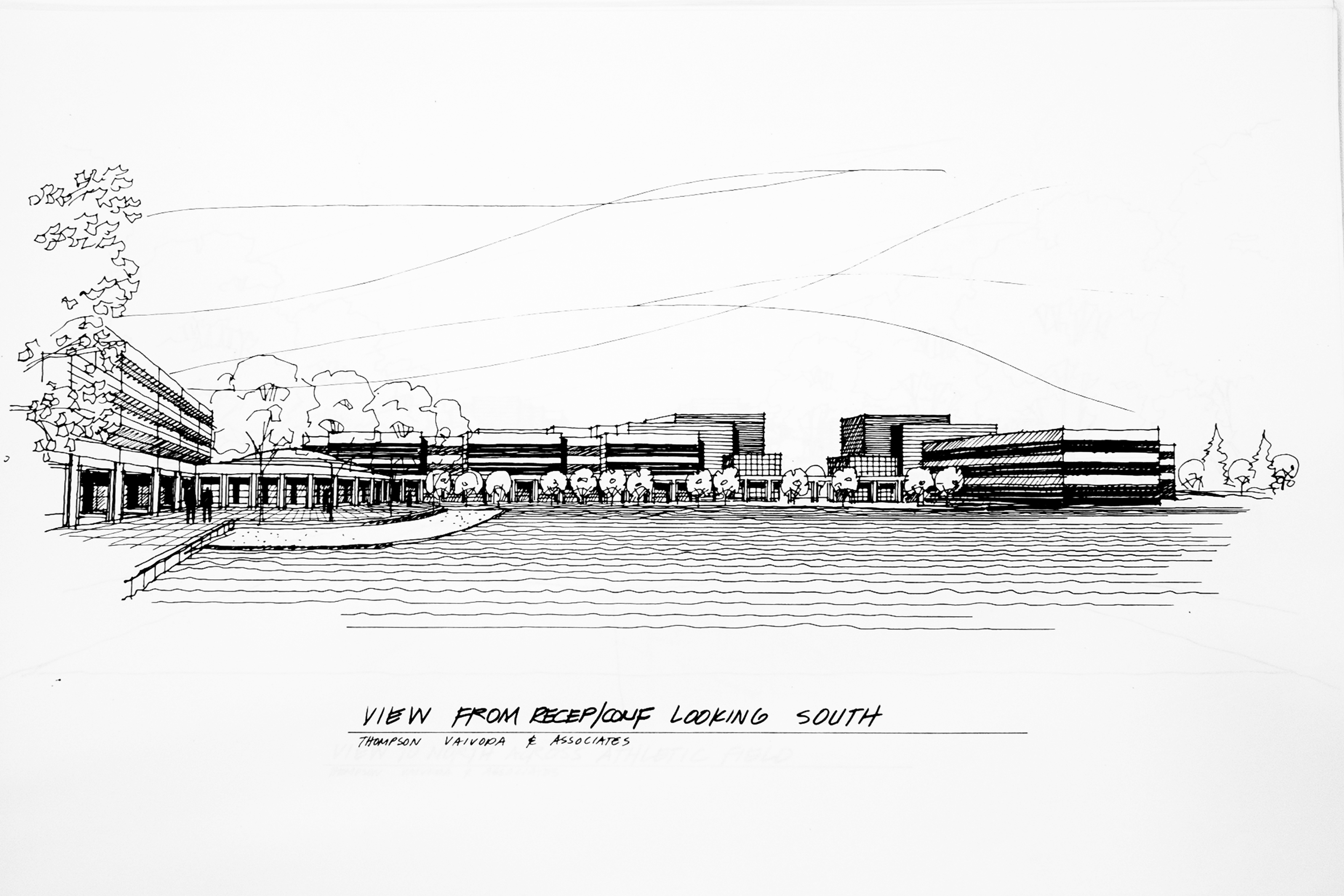
The earth that was removed to create the lake became a berm surrounding the campus — a quiet, tree-lined buffer that separated the company’s space from the outside world while creating running paths that looped through the property.
The effect was intentional. Drawing inspiration from the contrast of dense urban life and quiet interiors he had experienced in Japan, Knight envisioned a place that offered a sense of calm after the intensity of work travel.
“You’d go out and fight the wars,” he says, “and you’d come home and just want a place where there was peace.”
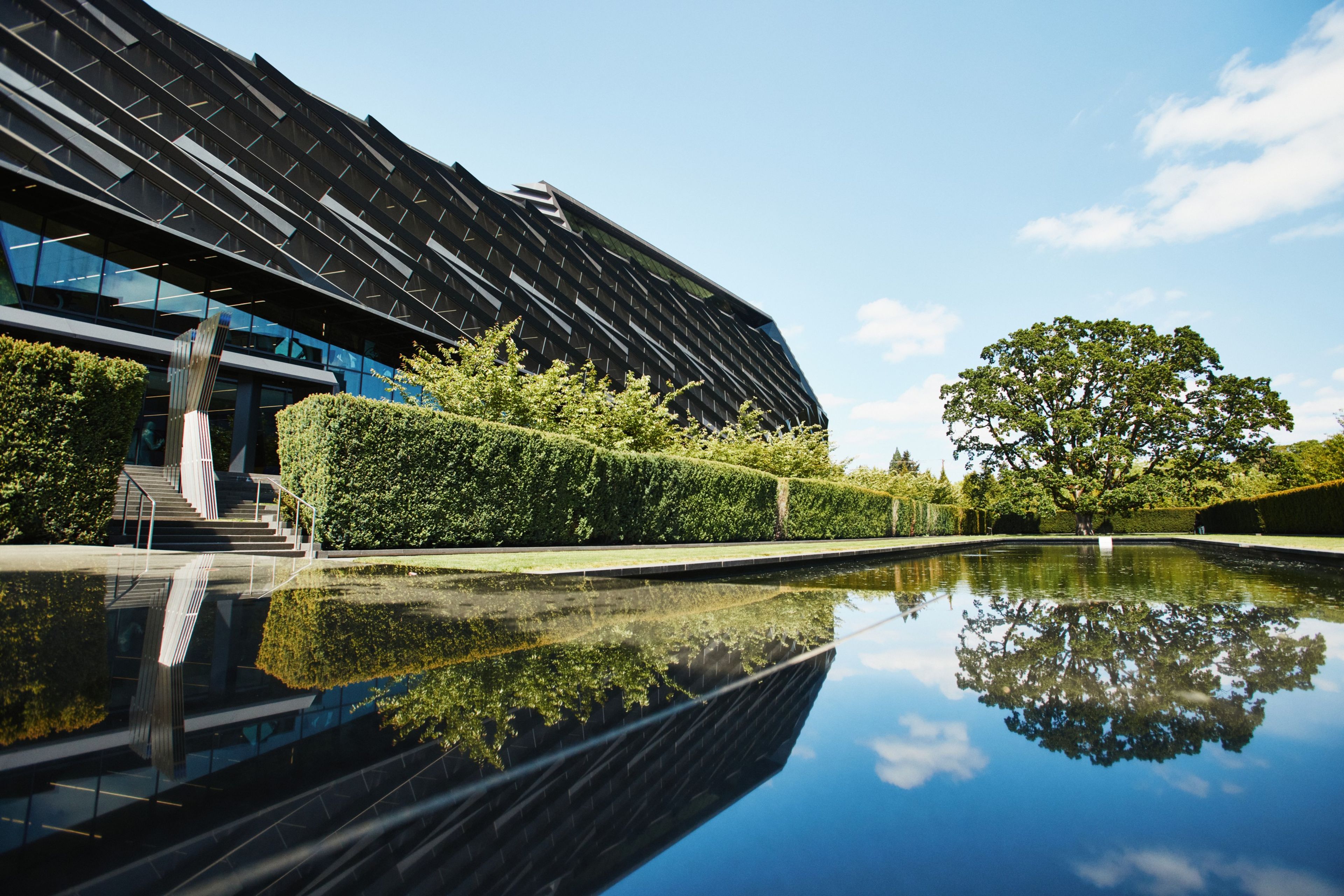
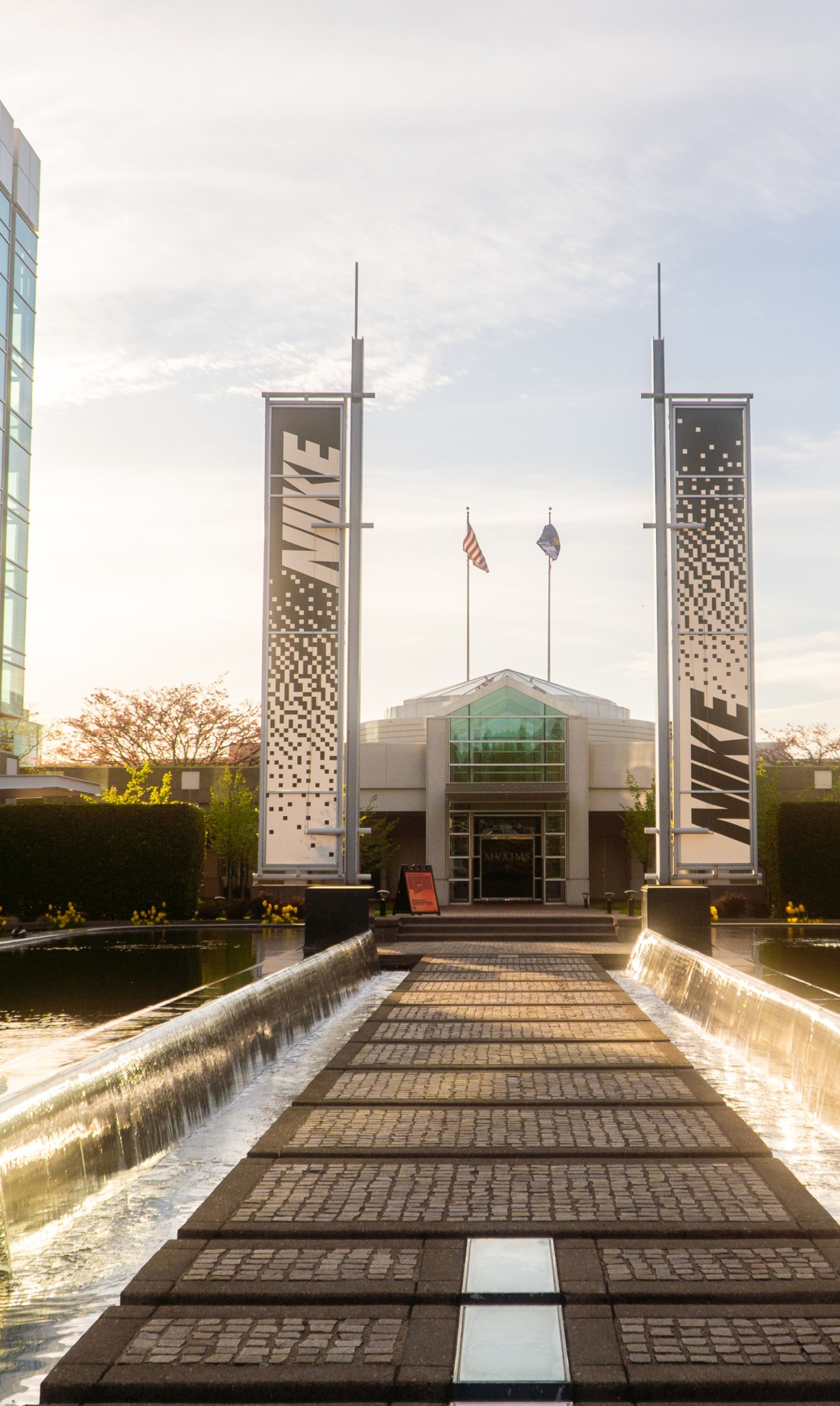
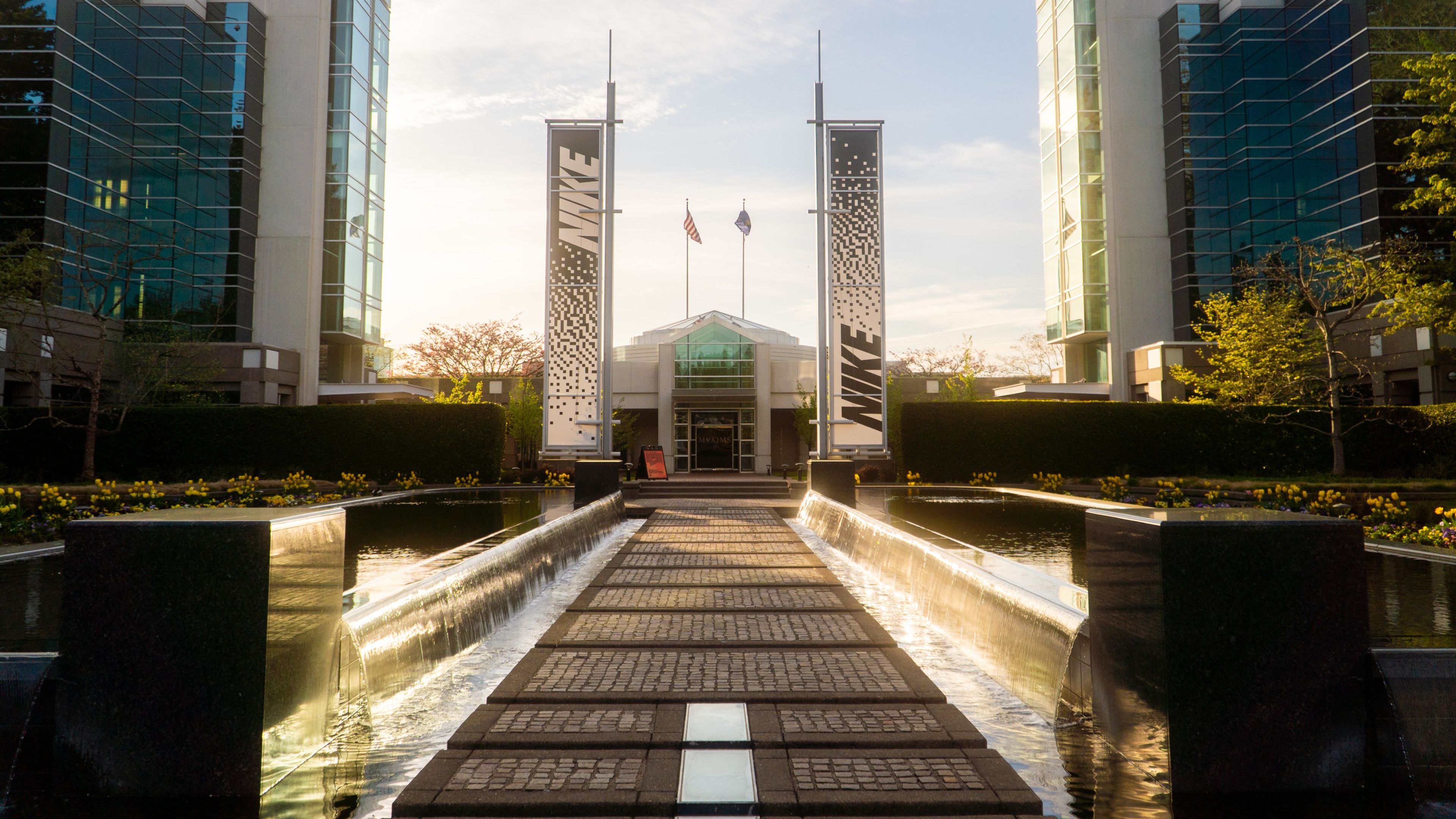
A reflecting pool outside of the Mike Krzyzewski "Coach K" Fitness Center.
“You’d go out and fight the wars, and you’d come home and just want a place where there was peace.”
Phil Knight, NIKE, Inc. Co-founder
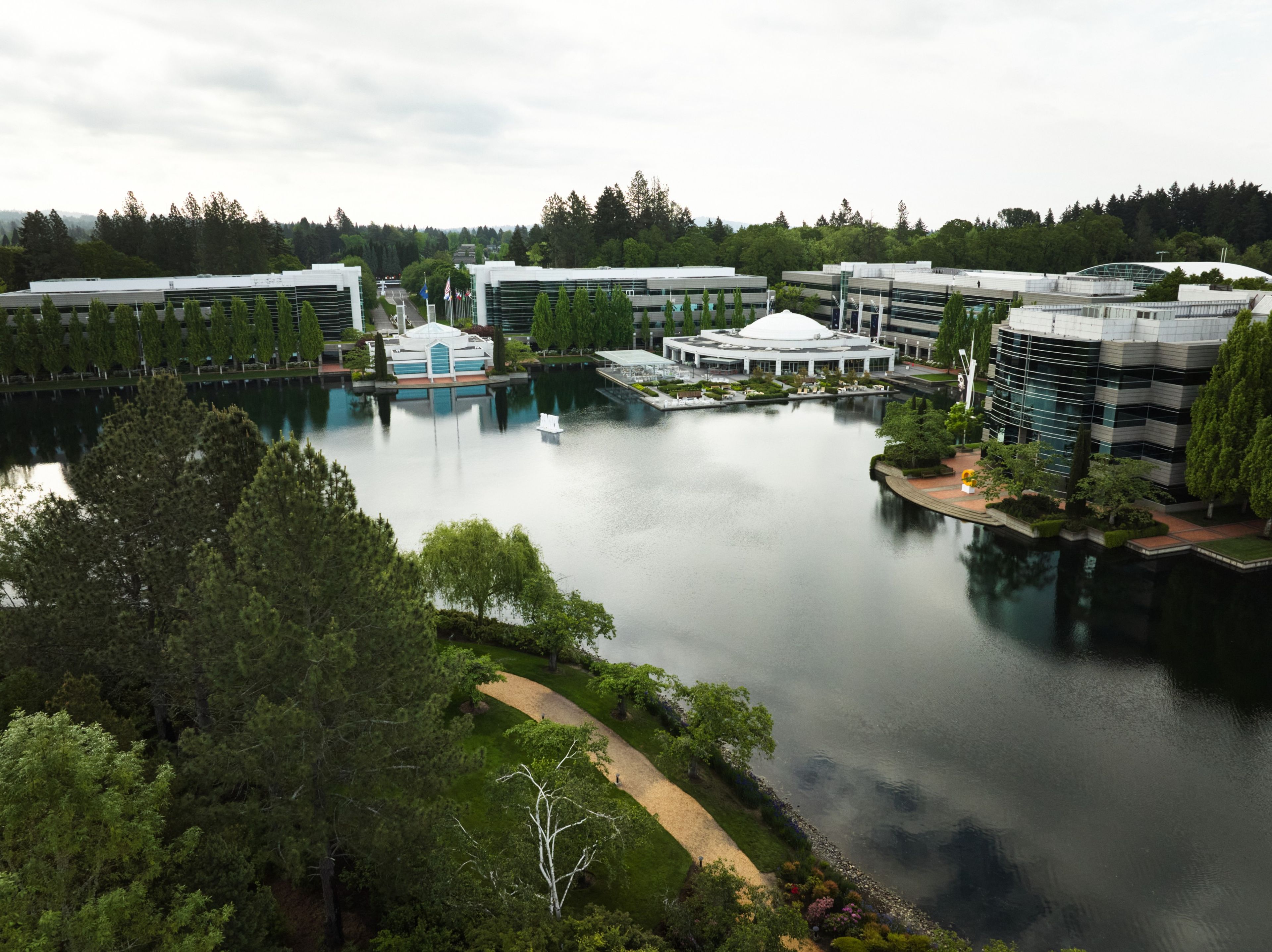
Nike world headquarters buildings, from left: Next%, John McEnroe, Prefontaine Hall, Michael Jordan and Mike Schmidt.
Even the buildings themselves reflected that thinking. Kept relatively low in the beginning, they were spread across the landscape to take advantage of light, space and the surrounding environment. With more land available, Knight and his leadership team made the decision to build outward rather than upward, favoring four-story structures over taller towers. Inside, design decisions prioritized openness and movement, with elements like expanded stairways introduced to bring in more daylight, even at the expense of usable office space.
From the beginning, the campus wasn’t just built to house a business. It was built to reflect its identity as a company shaped by athletes and the environments they move through.

The present-day Mia Hamm and Jerry Rice buildings.
As the campus took shape, even its buildings’ names reflected the company’s values.
Early plans that referred to the buildings simply as “A,” “B” and “C” were scrapped in favor of a system that better aligned with Nike’s sports culture.
“I said, ‘If you want to name our buildings that way, you’re going to have a heck of a time,’” recalled project leader Howard Slusher. “‘It doesn’t seem like who we are. Why don’t we just name them after our athletes?’”
That thinking reshaped the plan. Buildings were named for athletes who stood apart in their sport — Hall of Famers, figures who were head and shoulders above their peers.
The first buildings were named for icons like Steve Prefontaine, Joan Benoit Samuelson and Michael Jordan, a precedent that would continue as the campus grew.
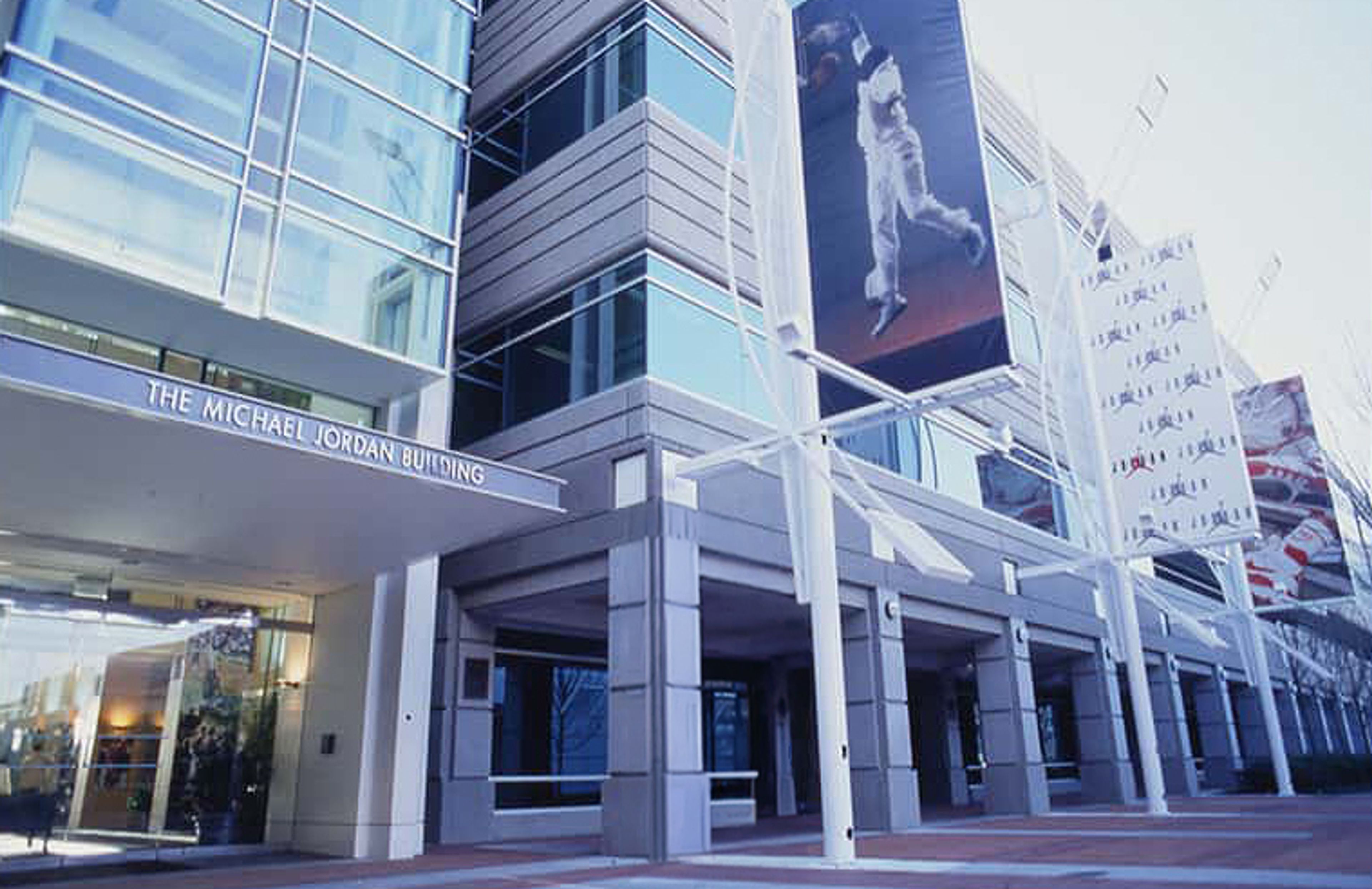
The Michael Jordan Building in 1990.
“I said, ‘If you want to name our buildings that way [“A,” “B” and “C” ], you’re going to have a heck of a time. It doesn’t seem like who we are. Why don’t we just name them after our athletes?‘”
Howard Slusher, Nike Campus Project Leader

The Bo Jackson Fitness Center and field.
The original campus came to be over a two-year stretch, beginning in 1990 with buildings such as Mike Schmidt and Michael Jordan, and continuing through 1992, culminating with the Nolan Ryan Building.
For the first time, the company had a place designed for how it worked — and for what it aspired to become.
It wasn’t just a headquarters. It was a foundation.
“Bringing the Footwear Design and Apparel Design teams together created amazing synergy,” recalls former Design Director Wilson Smith, who spent more than 40 years with the company. “We were separated only by an internal bridge between the two sides of the building...I don’t think it was coincidental that we look back on the 1990s as the golden age of product design.”
Growth came quickly — and in waves.
By the late 1980s, construction was moving in step with the company’s momentum, with new buildings added as demand surged. Nike officially dedicated its new headquarters in October 1990, bringing together employees who had long been spread across the region.
The pace didn’t slow. Within a decade, Nike expanded the campus significantly, roughly doubling its footprint as the business surged in the 1990s. The athlete-naming tradition continued, with buildings honoring figures like Ken Griffey, Jr., Mia Hamm and Jerry Rice, reinforcing the connection between the company and the athletes it served.

NIKE, Inc. co-Founder Phil Knight, right, with Jerry Rice at the Jerry Rice Building dedication in 1999.
The next phase wasn’t just about scale but also capability.
As Nike entered the late 1990s and early 2000s, the campus evolved to reflect a company no longer building with contingency in mind, but rather with confidence in its trajectory.
“The original campus was laid out in such a way that if Nike’s business took a sharp downturn — which was a threat in the 1980s — one or more of the buildings could be sold off or rented to another company,” explains Reames. “But the explosive growth in the 1990s cemented the idea that the second expansion would need no back-up plan, and the layout of the new buildings reflects that air of permanency.”
New facilities were larger, designed to support a rapidly expanding workforce and the increasingly complex demands of a global brand. Additions like the Tiger Woods Center, dedicated in 2001, created space for large-scale gatherings, from sales meetings to product launches, that previously required off-site venues. Each building expanded not just how much space Nike had, but what the campus could do.
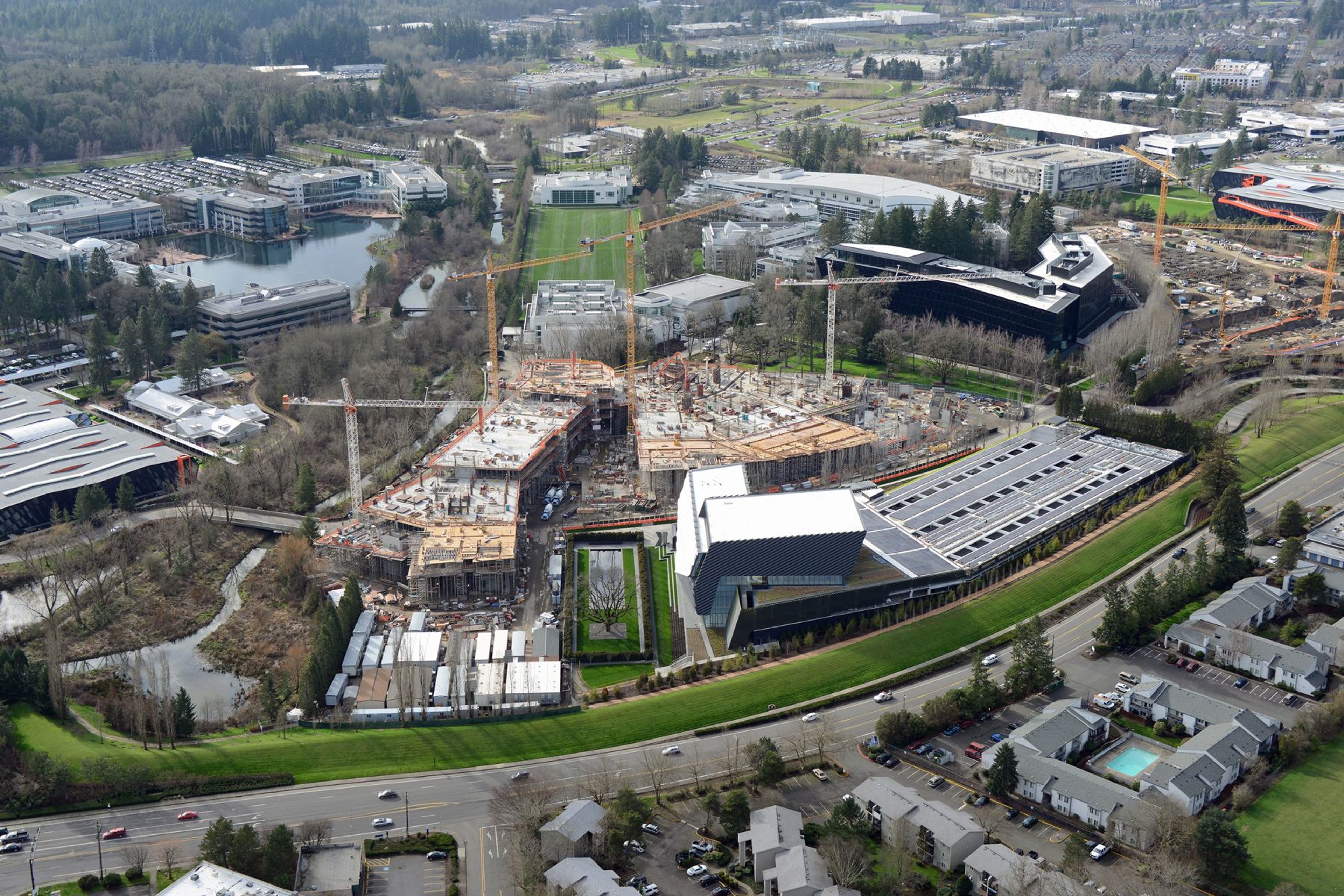
Construction begins on the Serena Williams Building in 2018.
The evolution culminated in a sweeping modern expansion that reshaped the campus once again.
Beginning in the late 2010s, Nike undertook a major development project that included three major new buildings across thousands of acres and more than 1.1 million square feet of new space. The expansion introduced a new architectural language — darker, more minimal structures designed with sustainability, performance and collaboration at their core — and brought together research, design and product creation in closer proximity than ever before.
“Nike leadership wanted world-class architecture that captured the ethos of the brand and reflected Nike as a leader,” says Gene Sandoval, partner, ZGF Architects, who led the design of the Sebastian Coe Building, which opened in 2018. “Seb Coe was designed to represent movement, dynamism and be an inspirational creative office space nestled in the North Wood Forest.”
Nike knew what it wanted from its structures. When Sandoval would bring plans to Knight and Howard Slusher, they would tell him to “go bigger.” Knight's philosophy was simple: if Nike was going to do this, it was going to do it big. Sandoval says he was continually struck by how seriously they took the idea that architecture should carry the culture and ethos of the brand.
That vision shaped every detail of the Seb Coe Building. Nestled in the North Wood Forest — and originally named for that forest — the building was designed around preservation. They were asked to preserve as many trees as possible, and they wanted the interiors to feel like you were part of the surrounding woods. This can be sensed strongly in the cafeteria, with the floor-to-ceiling windows looking out over the forest. The building was meant to feel like it was coming out of Oregon.
In its cantilevered front, a water element anchors the structure’s most striking feature. The original plans called for the cantilever to reach 60 feet from base to tip — until Sandoval showed them to Mark Parker, who pushed for more. They ended up doubling it. At 120 feet, it stands as an engineering marvel unlike any other building in Oregon.
At the center of the architectural transformation was the LeBron James Innovation Center, which opened in 2021, representing a sea change in how Nike develops product. At its core was the groundbreaking Nike Sport Research Lab (NSRL), a world-class innovation laboratory built to study athletes in motion. Equipped with hundreds of motion-capture cameras, dozens of force plates and advanced testing environments, the lab allowed researchers, designers and engineers to observe performance in real time and translate it directly into innovation.
“The NSRL is the epicenter of where we work with athletes of all abilities, all backgrounds, all skills and all sports,” says Matthew Nurse, Nike Chief Science Officer.
If the LeBron Building represented a leap forward in sport science, the Serena Williams Building reflected an equally ambitious investment in creativity.

Nike teammates frequently use the ramp of the LeBron James Building for workouts or (uphill) walking meetings.
“The NSRL is the epicenter of where we work with athletes of all abilities, all backgrounds, all skills and all sports.”
Matthew Nurse, Nike Chief Science Officer
Opened in 2022, the 1-million-square-foot structure is the largest on campus and one of Nike’s most significant commitments to design. It brought together teams across product, insights and merchandising in a single space, designed to accelerate collaboration and push new ideas from concept to reality. Dedicated labs, immersive environments and expansive showrooms allowed teams to test, visualize and refine ideas at scale.
“The whole building takes your breath away,” says Serena Williams of the building named after her. “Every element, everywhere you go, is an opportunity to be inspired.”
The more recent additions marked a new era for the campus, one characterized not just by growth, but by integration. Science and creativity, research and design, all working side by side.
Taken together, decades of considered decisions have created something rare at the Philip H. Knight Campus: a workplace that operates at the scale of a global company, but can feel like a personal, immersive home for its teammates.
For first-time vistors, the impression is immediate. Walk the campus, and open fields and tree-lined paths reshape your sense of distance. Crossing from one side to the other can take 15 minutes or more, and the setting shifts constantly, from wide-open spaces to scenic stretches that feel hidden within the landscape. Like any special space, the people give it its energy. Teammates pass one another between meetings, mid-conversation or mid-stride in moments that feel closer to a college campus than a corporate office, raising quick waves as familiar faces cross paths throughout the day.

Seen from above, the sprawling Serena Williams building creates the shape of a goddess' wing.
It’s the kind of place Phil Knight envisioned early on. Somewhere you come back to reset and prepare to go again.
“I worked at Nike for 30 years and studied it closely as the company’s historian for 17, and I truly believe that the creation of what is now the Philip H. Knight Campus was a catalyst that fostered an unprecedented era of creativity and innovation,” says Reames. “If the Nike campus is the nucleus, then its employees are the electrons, bouncing off one another to create energy, light and ideas.”
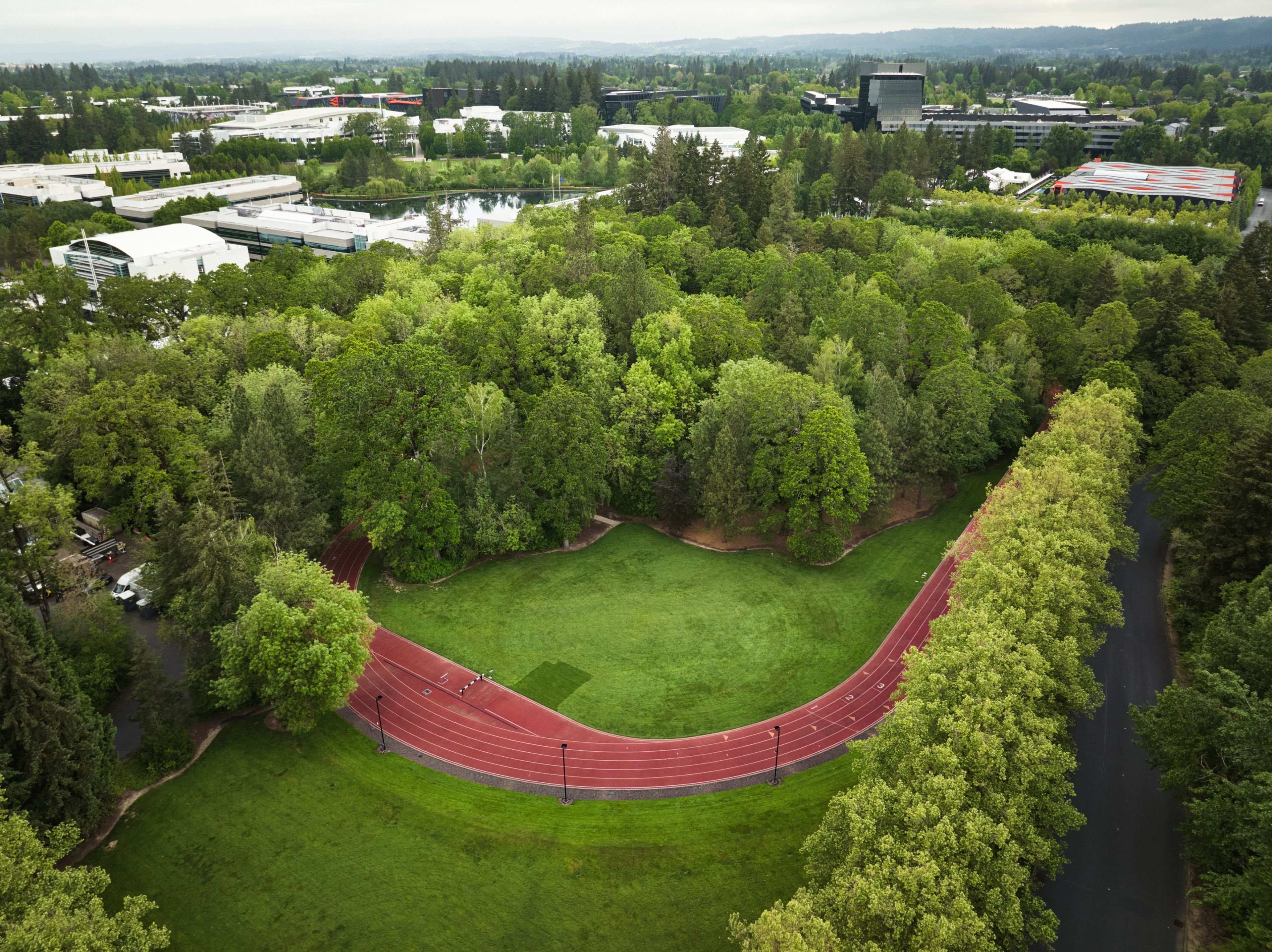
The Michael Johnson Track offers a world-class training ground in the middle of a natural environment.
“This is more than a name change. It’s a tribute to the man whose vision created a global movement.”
Elliott Hill, President & CEO, NIKE, Inc.

Ronaldo Field is a practice space for professional teams and pick-up employee soccer games alike.
For more than three decades, the campus has been known simply as Nike World Headquarters, the center of a company that grew from a basement operation into a global force.
In 2025, it was officially renamed the Philip H. Knight Campus, cementing its connection to the company’s co-founder.
“This is more than a name change,” wrote Elliott Hill, President & CEO, NIKE, Inc., in a letter to Nike employees. “It’s a tribute to the man whose vision created a global movement. And it’s a reminder, to every one of us who will walk these paths and run these fields, of what can happen when belief meets action.”
The renaming will be formally marked on May 21, 2026, a moment designed to bring the Nike community together around the legacy — and future — of a space that has shaped the company for more than 35 years.
In that sense, the renaming doesn’t mark a new chapter as much as it clarifies the one Nike has been writing all along. From a basement laundry room to a world headquarters spanning hundreds of acres, the throughline remains the same: a belief in athletes, in innovation, and in knowing that the greatest is always yet to come.
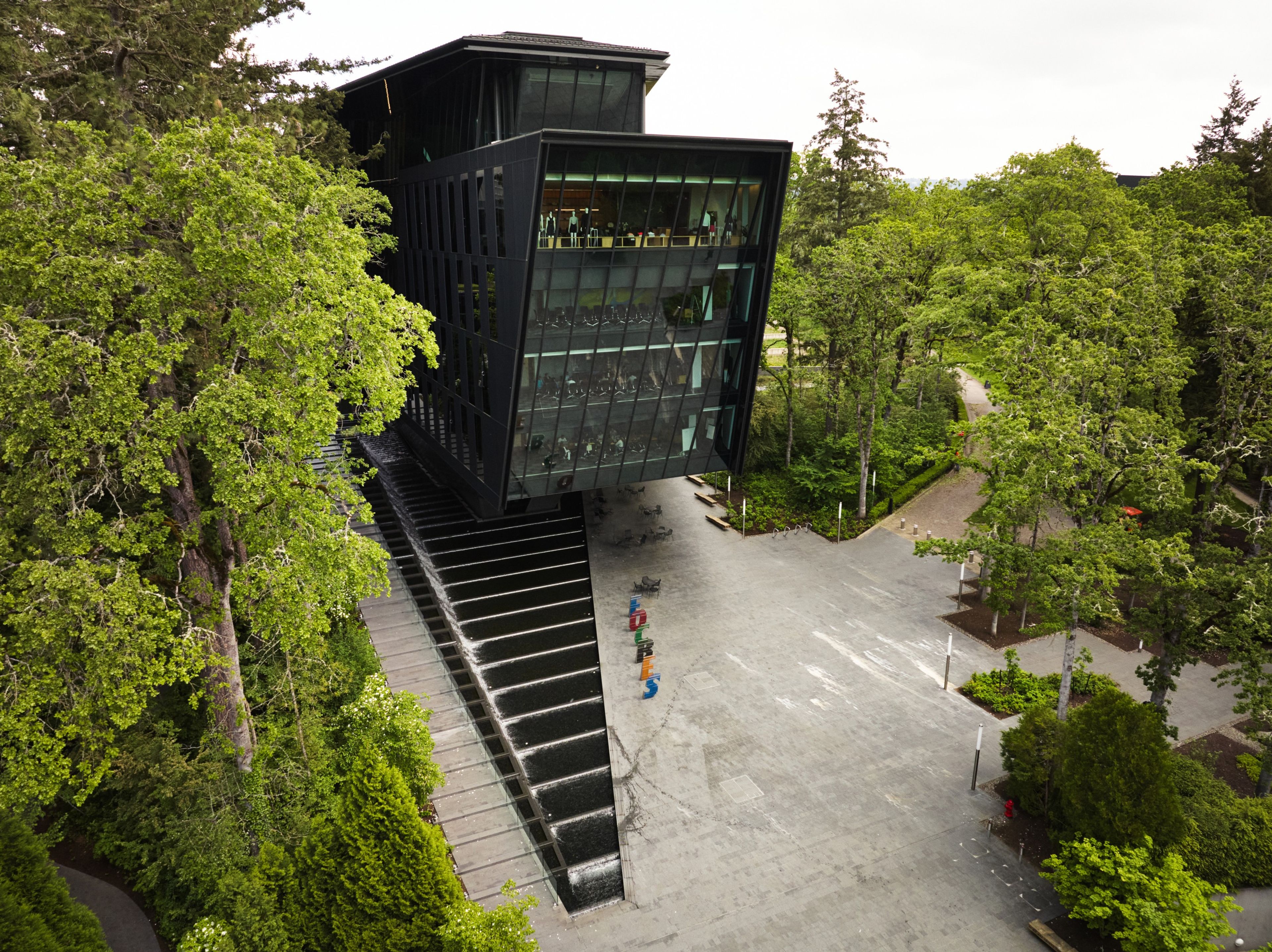
When NIKE, Inc. CEO & President Elliott Hill returned to the company, one of his first asks was to turn the fountains at the Sebastian Coe building back on “because it signals we're back in our flow."