Less Is Max In the Newest Version of Nike Air
- April 16, 2026
On the raucous machinery floor of Nike’s Air Manufacturing Innovation facility, a group of engineers study an inflated Air Max unit prototype. Its shape is stunningly technical. This “clover” unit, the visual cue that would later become the flowering, minimalist Air bag for the new Nike Air Liquid Max, is curved to help the wearer glide from each step to the next. The ride is meant to be incomparably smooth.
But there’s a catch. The unique shape of the bag is so complex it needs a lot of special attention. It’s the first Max unit to include internal cut-outs. The trim, or the perimeter of the bag, is complicated to get right. Air Max engineers have a word to describe Air: elastomeric. It means that Air has the ability to transform based on changing variables like temperature and humidity. As soon as you introduce more complexity to the shape of a filled Air bag, the harder it is to cut it to a precise shape over and over again across a full size run. Think of a cookie cutter mold. The more complicated the shape, the greater the margin for error when you slice the dough. Now imagine that dough is curved upward. That’s the case for this Max Air bag, and any dip or rise in room temperature can make the bag change shape ever so slightly. What's more, the same design has to be replicated hundreds of thousands of times.
High complexity. High precision. All in a minimalist silhouette meant to feel like the most nothing Max ever.
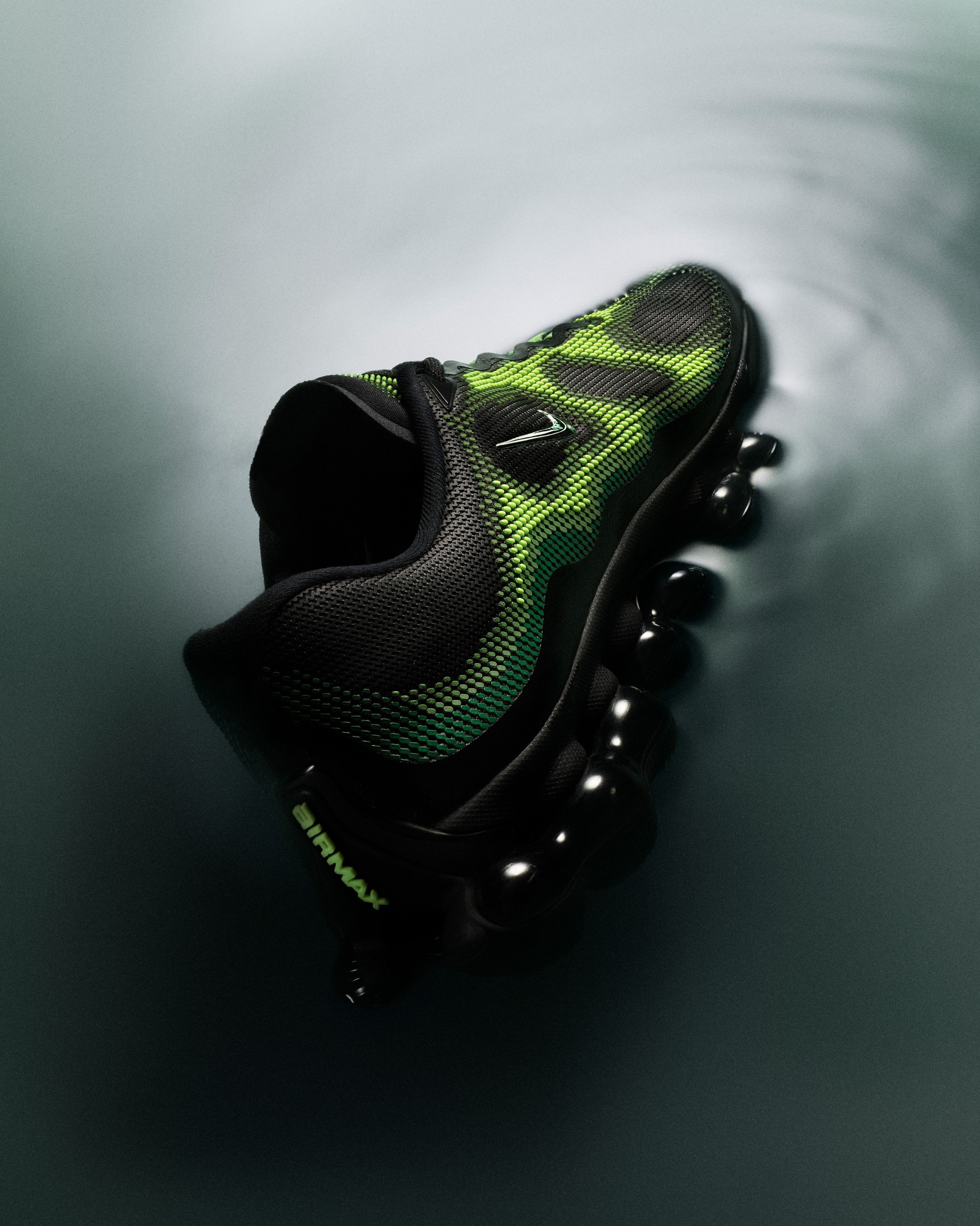
Nike innovators applied a systematic, less-is-more approach to every component of the Liquid Max.
What does it mean to walk on Nike Air? There’s the comfort, obviously. Every step should feel effortless. Then there’s the unmistakable look, beginning with the Air Max I in 1987, when the big see-through bubble was actually a prism into the future of shoe cushioning. But Nike Air could never just be a platform built on inspiration. It needed to be built on technical rigor to give a precisely tuned feeling. While the evocation of “walking on air” is easy, creating it is anything but.
The silhouette was originally briefed in 2019 and tag-lined “The Most Nothing Max.” The goal was to create an Air Max that felt light, fluid, flexible and barely detectable — a goal that’s historically been at odds with the platform.
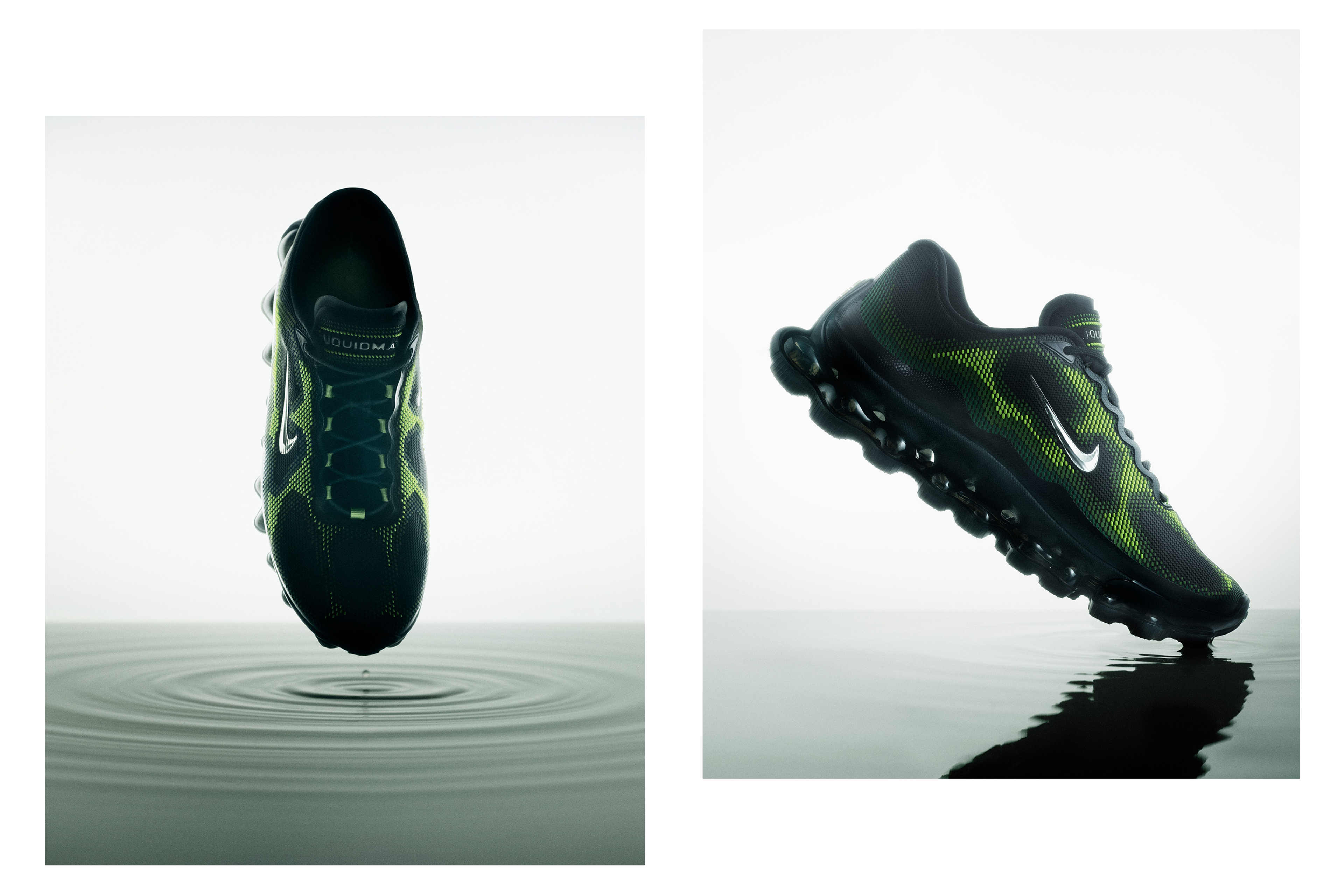
Walking on the Liquid Max unit had to feel fluid. Creating that feeling is an exciting technical challenge for Nike innovators, designers and Air MI engineers.
In an Air Max legacy that was founded on the big bubble, designers wondered whether an Air Max unit could, should, feel like nothing. A filled Air bag, when combined with layers of cement foam and rubber, can come across as rigid and slappy, making it challenging to feel a smooth step-to-step transition.
“Liquid Max had to set a new visual precedent, but the Air unit also had to give a new sensation for walking on Air,” says Ditte Kuijpers, Design Director, Nike Sportswear Innovation Footwear. “People needed to both feel and see how it was different. Every component of the shoe had to work together for this to happen.”
“Liquid Max had to set a new visual precedent, but the Air unit also had to give a new sensation for walking on Air.”
Ditte Kuijpers, Design Director, Nike Sportswear Innovation Footwear
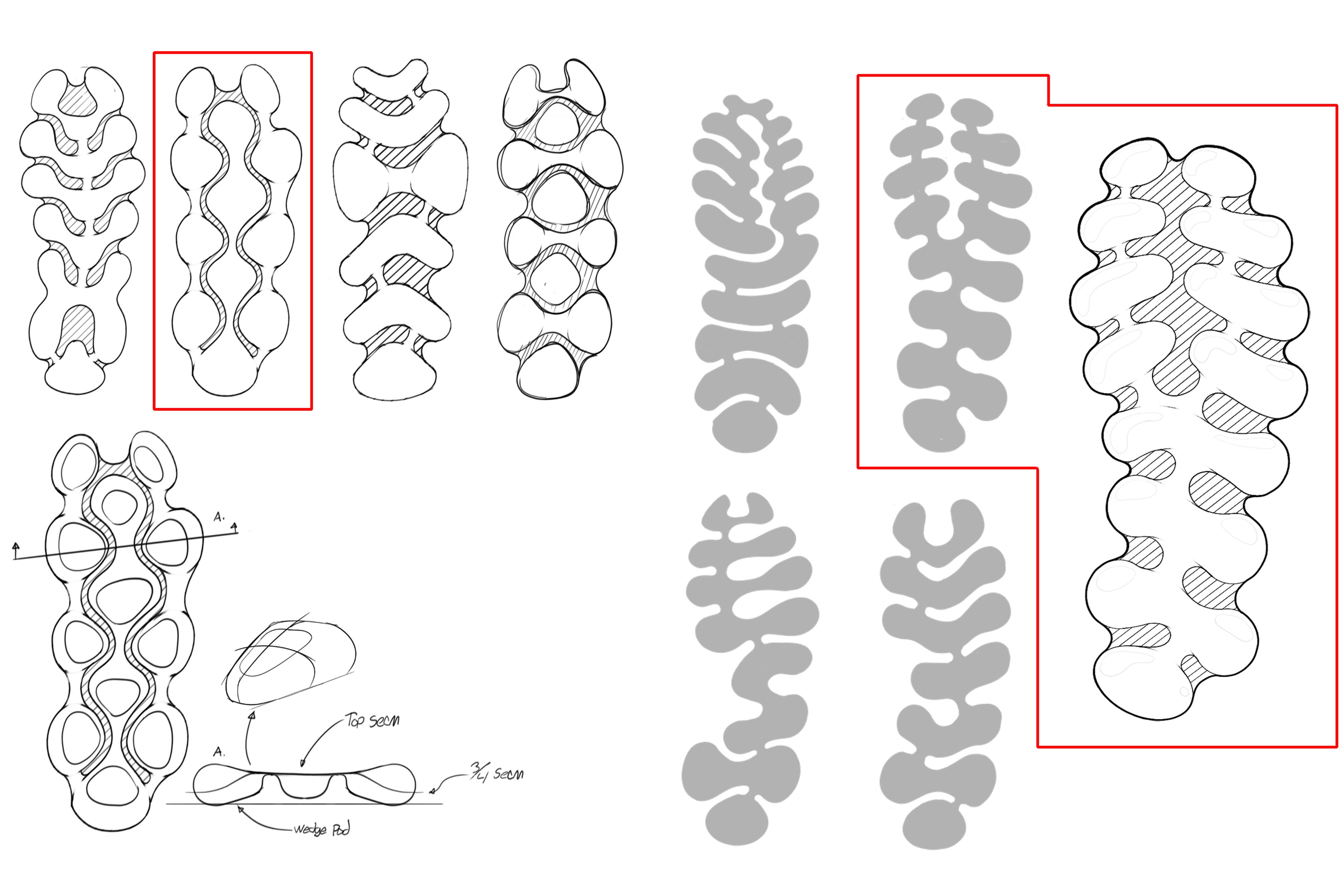
No option was off the table in brainstorming the earliest versions of the Liquid Max unit. The team gave itself permission to break from Air Max models of the past.
To begin, designers and engineers discussed how this unit would break from Air Max models of the past. A few key descriptions stood out as inspiration: Sleek. Reductive. Minimalist. The Air Max unit had to be lighter and more flexible than previous models. When Nike designers began conceptualizing this sleeker unit, one source came from an unlikely place: Air Max Scorpion. Released in 2021, it was maximalist in the truest sense, featuring an enormous unit shaped by ambitious proportions. It was the largest unit ever created in terms of volume of Air per square inch. One observation stood out from designing the Scorpion bag: its emphasis on a term called “point loading.” This is when each area of cushioning is precisely mapped against the entirety of your foot, comfortably spreading your bodyweight out on certain points of the bag. Each part of the Air unit can have a different stiffness or softness.
“Scorpion gave the team a good starting point,” says Wade Flanagan, Director of Nike Air Innovation. “We learned new techniques that could help us tune the bag for flexibility across different zones. Comparing the Scorpion bag to Liquid Max, we wanted to make something lighter, more flexible, more minimalist, but just as responsive.”
But cutting the bags to achieve this effect is complicated, says Flanagan. Each Air bag almost has a mind of its own because of how it can change in the slightest of circumstances. Trimming each one perfectly, he says, is like hitting a moving target.
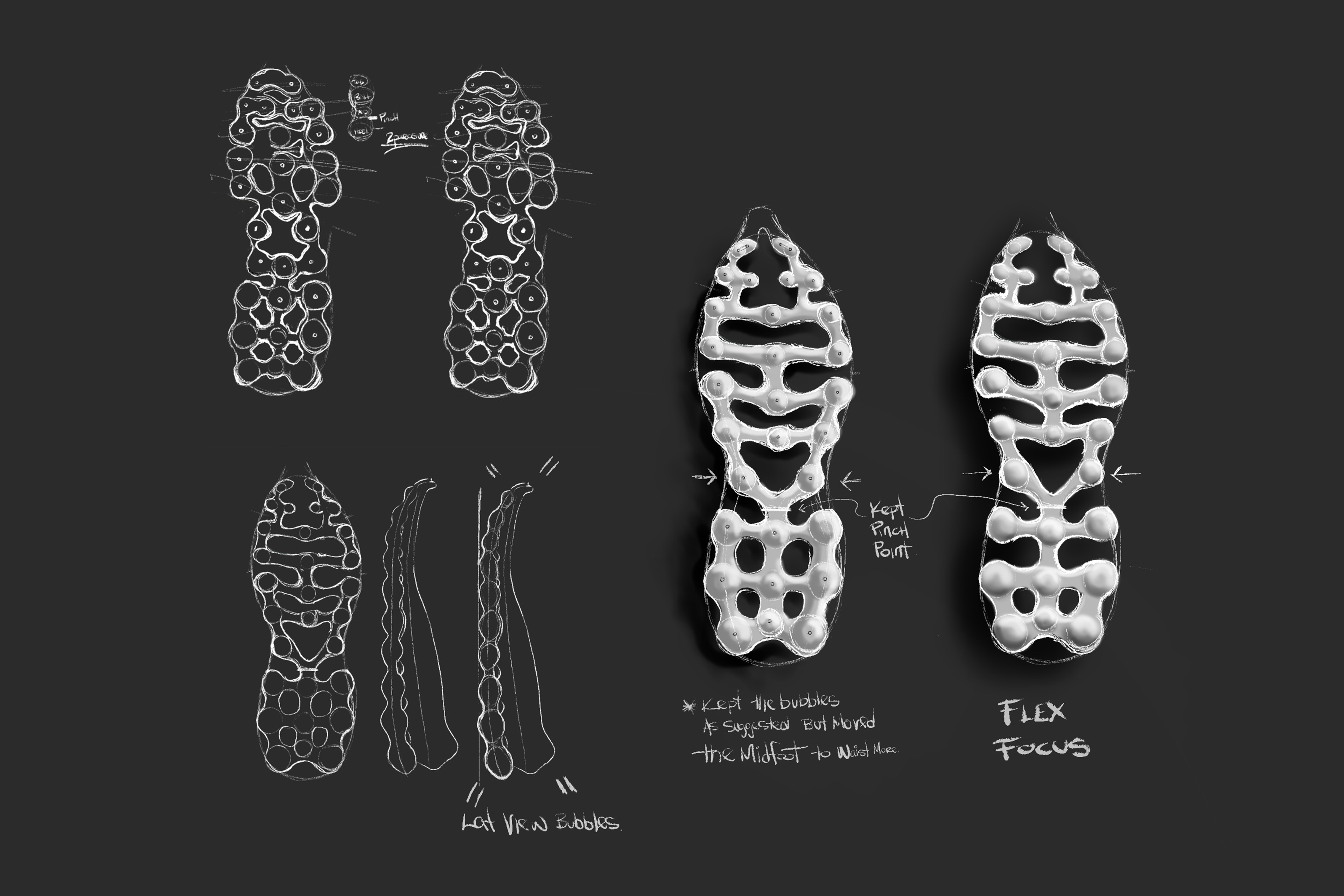
Using a combination of tactile expertise and high-fidelity tools, the team created an entirely new molding process that ensured a precise, ornately designed bag every single time.
The silhouette’s name shifted to Liquid Max for good reason: The unit had to move with a undetectably smooth transition, like liquid. One of the designers’ early prototypes used a modified version of the Air Max DN8’s Air units, a row of pressurized tubes across the full length of the foot. To create a more contoured system that worked with the foot, and to reduce the number of parts in the shoe, designers experimented with different versions of a drop-in midsole.
Some prototypes of the Air unit were more organic. Others were more industrial. Some shapes tried turning visual details into mechanical advantages. Could a sly spelling of “Air Max” on the outsole create a trampoline-like effect through the middle of the letters? The possibilities were wide open. Testing wasn’t limited to the physical world, either. A digital method called Finite Element Analysis, or FEA, helped designers simulate the real-life forces of a person walking in the shoe, putting pressure on different regions of the unit and then measuring how it responded.
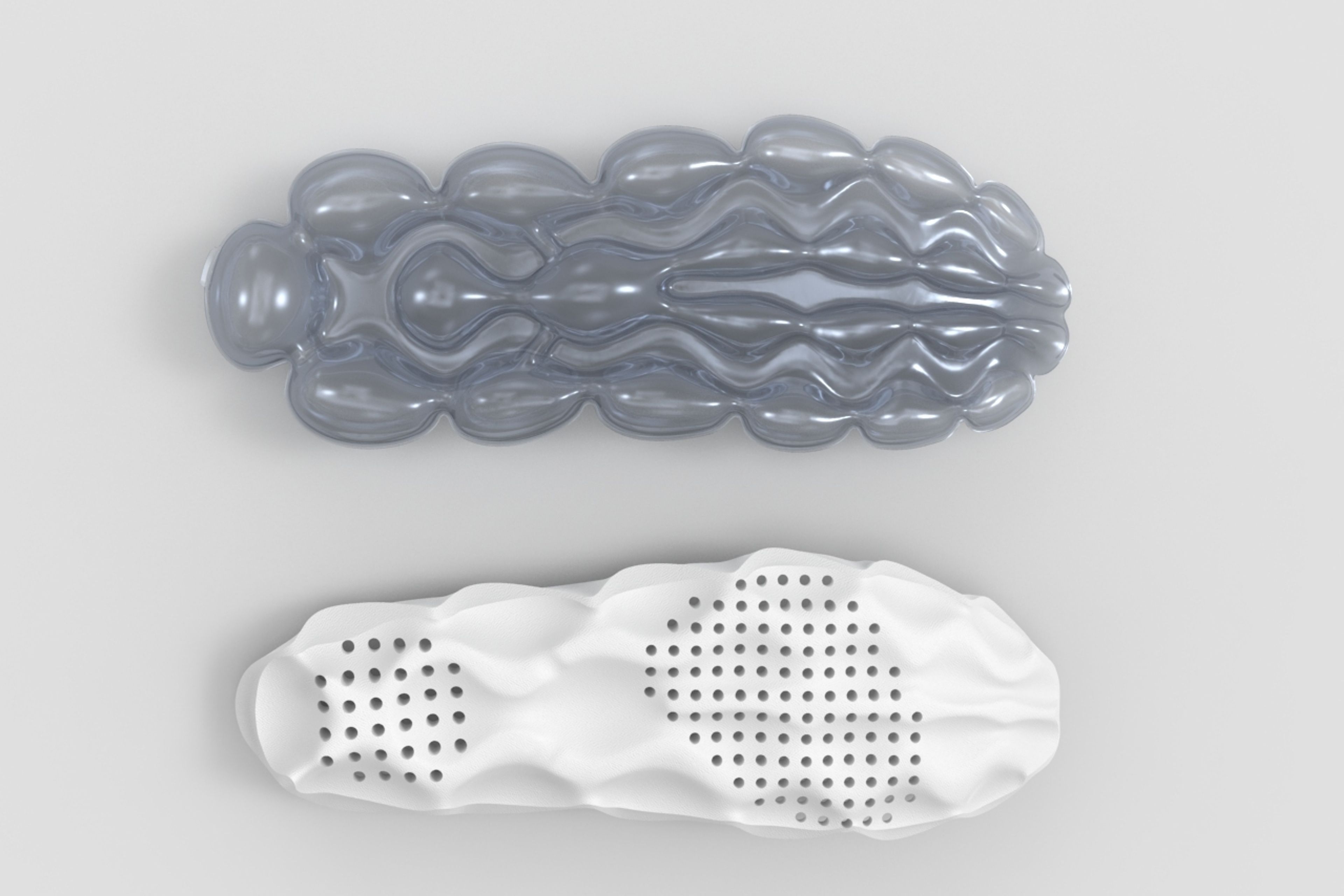
Early versions of the drop-in featured grooved ridges on the underside of the foam, which were uniquely matched to different regions of the foot based on pressure maps from the NSRL.
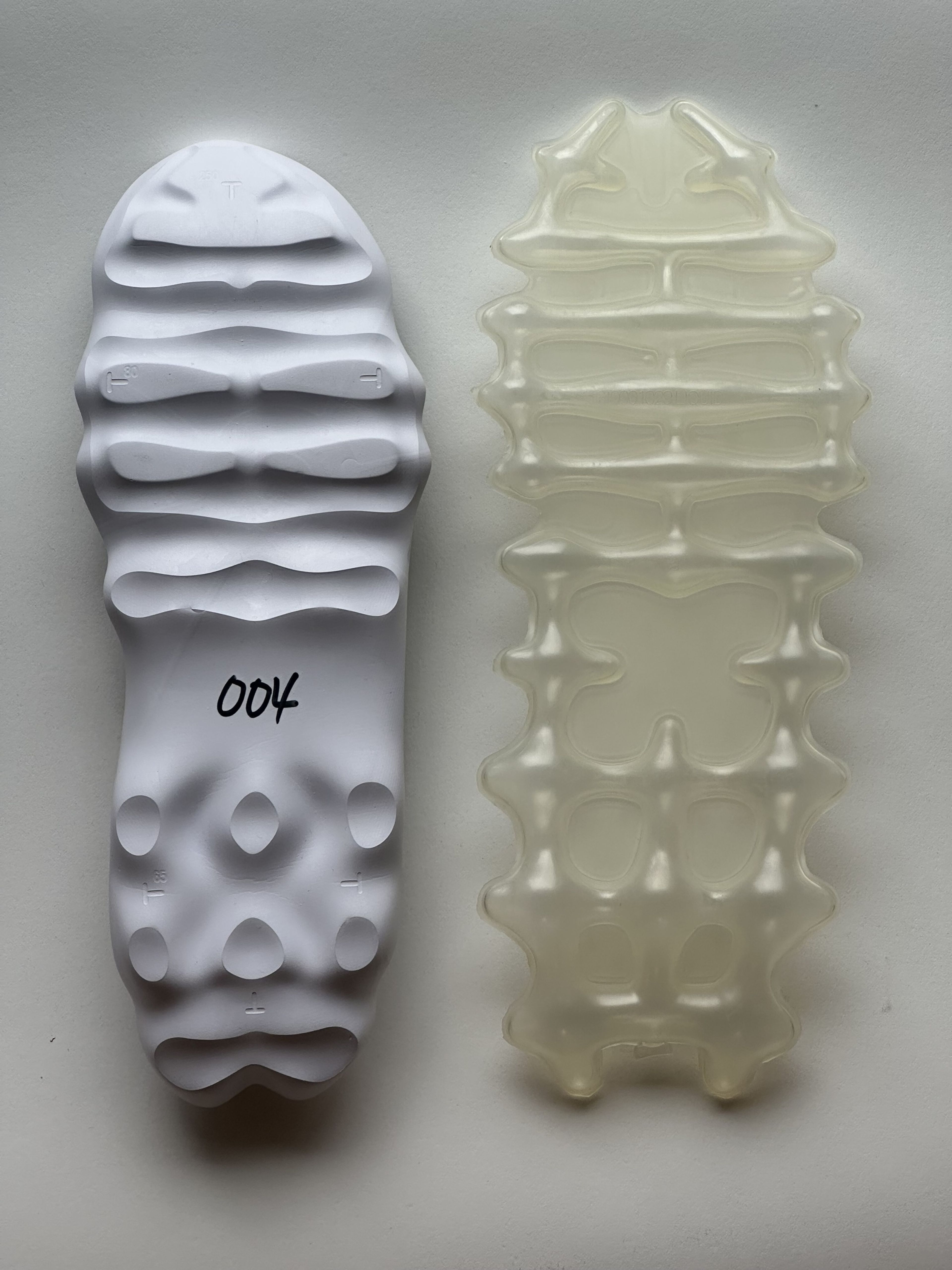
This testing through trial and error helped designers and engineers land on a beautiful, two-chambered, full-length Air unit design. Maybe its most noticeable shift from Air units of the past was also its most challenging on a technical level: cutting out inserts in the bag; coring out unnecessary parts in the middle; and molding it in a curved, rockered shape to make it more minimalist. Trimming a unit this complicated inside and out, on a curve? It hadn’t been done before. It would require a more precise kind of Air manufacturing.
“The Liquid Max unit is an example of when our designers, engineers and Air MI technicians set their sight on a challenge and overcome it.”
Wade Flanagan, Director of Nike Air Innovation
The Liquid Max team began working closely with the technicians at Nike’s Air Manufacturing Innovation (Air MI) facilities in Beaverton, Ore. There was basically no margin for error. Cut the bag at a poor angle, and the bag can pop. Cut it too wide, and you leave behind messy, awkward flanges around the perimeter. A dynamic ingredient like Air is also highly sensitive to the environment around it, meaning the bag can change shape in an instant based on the indoor temperature, resulting in inconsistent sizes. Air unit manufacturing is the equivalent of baking the world’s coolest soufflé.
The final version of the Liquid Max Air unit is what happens when bold creativity meets manufacturing ingenuity. And the strategies employed to make the Air unit go beyond any single shoe.
“The Liquid Max unit is an example of when our designers, engineers and Air MI technicians set their sight on a challenge and overcome it,” says Flanagan. “A lot of that comes from being inspired to challenge limitations and push Air Max to a new place so we can provide new benefits to people who wear it.”
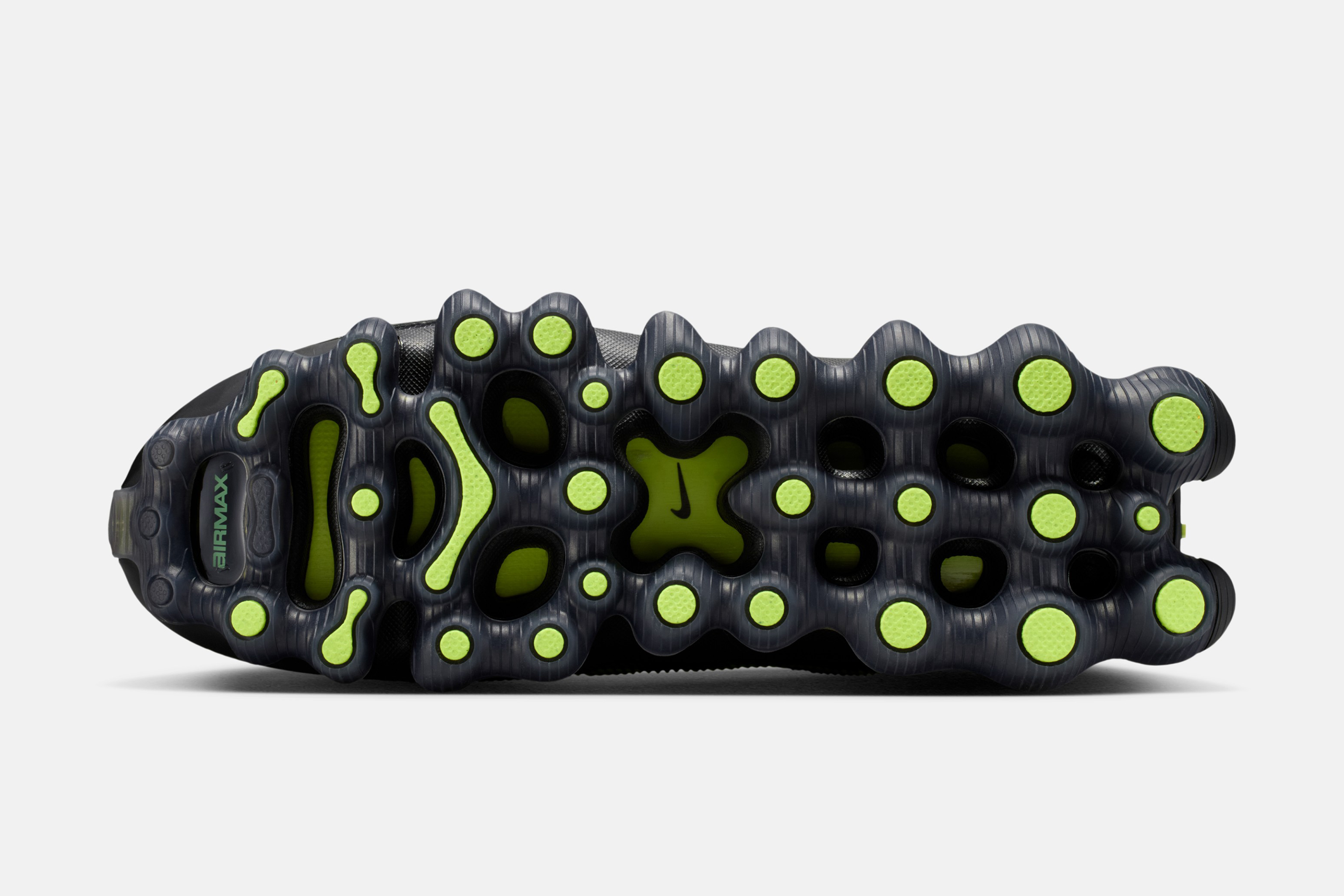
Liquid Max ushers in an era for the Air Max franchise where precision and complexity go hand in hand.