How Can I Improve My Mind-Body Connection?
- January 15, 2026
Athletes need to master their minds as well as their bodies. For the first time, Nike’s cracked a neuroscience-backed way for its footwear to help create a better connection between an athlete’s body and mind.
How to Understand it
Nike’s Mind Science Department – a part of the Nike Sport Research Lab – has spent years thinking about how to improve the mind-body connection to help athletes better prepare, train, compete, and recover. Graeme Moffat, PhD, a principal researcher on the team, helped gather insights that led to the Nike Mind platform, a complex scientific, engineering and manufacturing technology more than a decade in the making. A neuroscientist by trade, Moffat studies the interaction between footwear and the body’s central nervous system, which is guided by sensation.
“One of the problems that everyone faces, but especially athletes, is when you get into your head and you start ruminating,” says Moffat, “and one of the easiest ways to get out of your head is to bring your attention back to the present moment. You can achieve this by focusing on your body and on your sensations of the world around you. You look around. You listen. You close your eyes and feel the ground underneath your feet.”
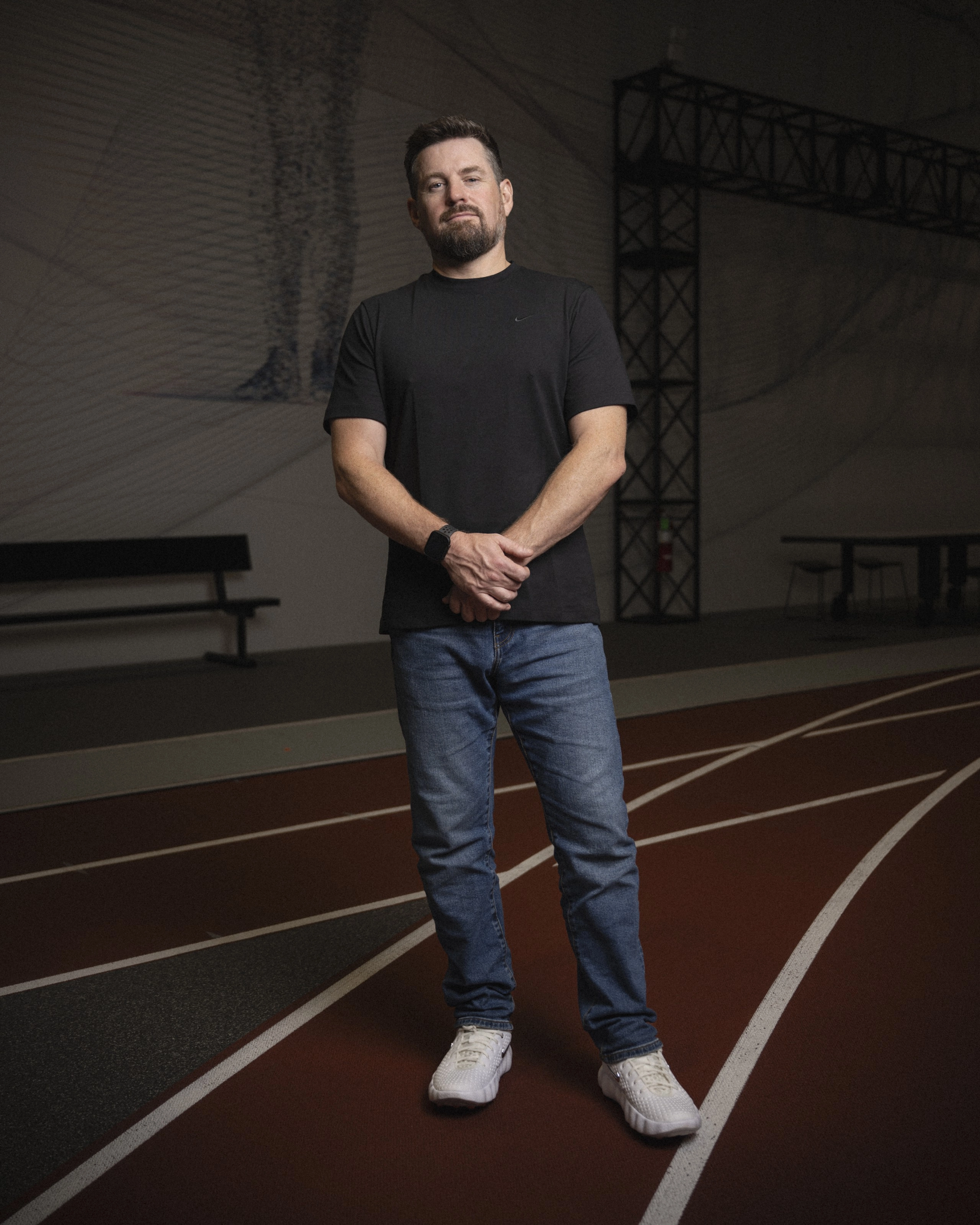
Graeme Moffat, PhD. Principal Researcher, Mind Science Team
Those brutal self-criticisms about how you’re not prepared or how you should just throw in the towel (pick your putdown) can be mapped to activity in a specific network in your brain called the Default Mode Network, or DMN. This network is responsible for self-referential thinking, rumination and daydreaming — you know, when your mind starts to wander. Sometimes, that's not for the better. Daydreaming is good when you’re thinking about that trick play from last week’s playoff game. It’s not when you’re preparing to compete in the semifinal in fifteen minutes.
Neuroscience research shows that other brain networks are inactive when the DMN is active, and vice versa. Chief among these is the main driver for movement, touch, and body sensation, the Sensorimotor Network (SMN). When the Sensorimotor Network activates, it unites what you’re sensing with your body’s motor skills to help guide your movements. A hard plant off the back foot for a baseline cut. The correct wrist placement for a devasting forehand slice.
Think of it as two teams. On one side, there’s the DMN, voiced by the swirling self-talk that can help you daydream, but can also send you into a tailspin of self-doubt. On the other, there’s the SMN, calmly reminding you to turn your gaze outward to what’s unfolding around you and get moving. Both networks are trading control of your attention, a bit like two teams fighting to maintain possession of the ball.
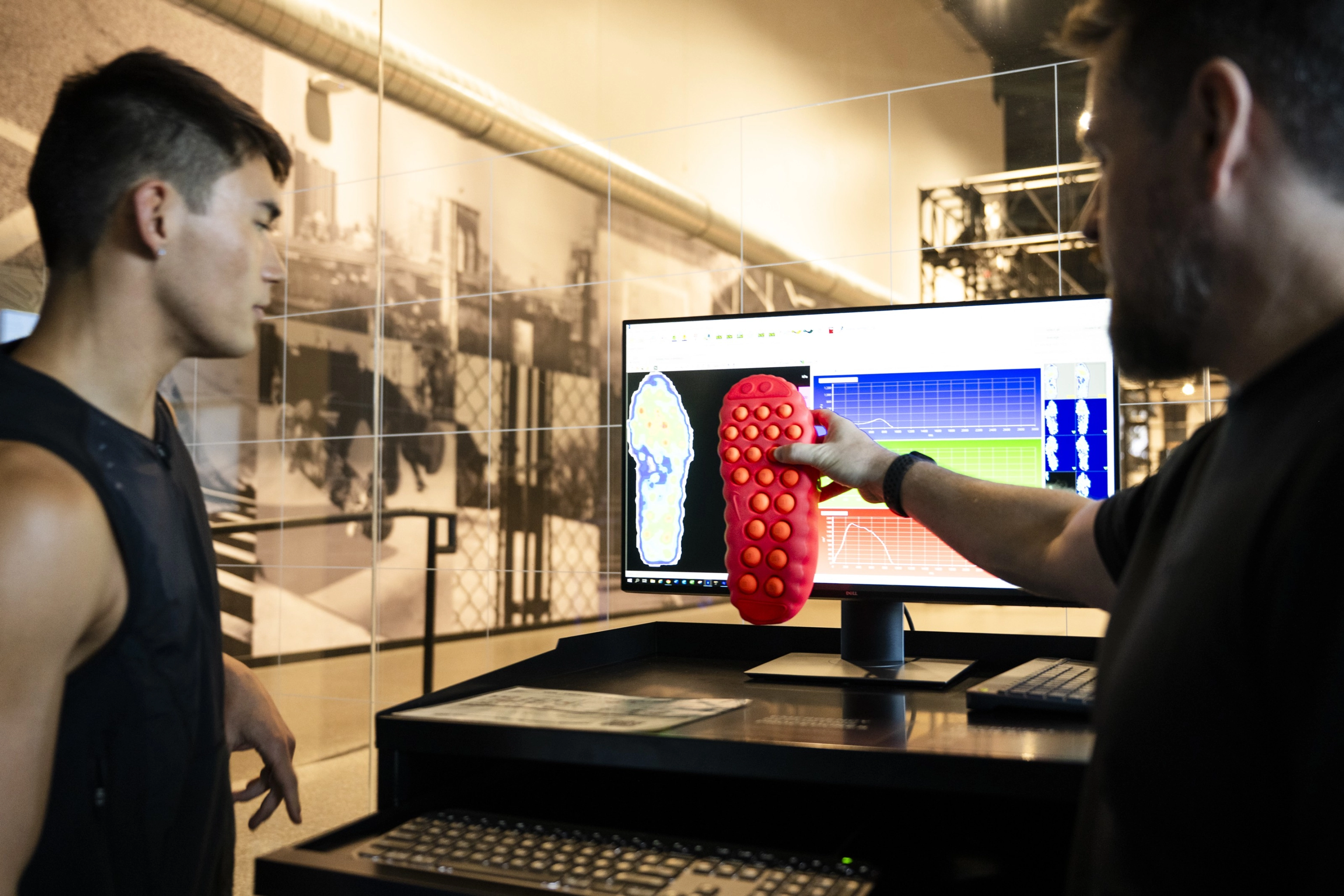
The bottoms of your feet have 10 to 20 times more mechanoreceptors than most other areas of the body, making them highly sensitive to sensation.
How We Approach it
The bottom of the human foot, and especially the forefoot, is rich with neural receptors. When your foot is stimulated in these highly sensitive areas, electrical activity is transmitted through your central nervous system, into your brain, and back down to your muscles to help you stand and move. This fact led to the design for the Nike Mind platform’s first shoes, the Nike Mind 001 and Nike Mind 002, created to help activate an athlete’s senses to enhance their pre- and post-game routines.
When testing for Nike Mind footwear began, Nike’s scientists explored how the shoe’s design could optimally stimulate sensory neurons in the foot, and from there, activate the Sensorimotor Network to help bring an athlete’s attention back to their own body and to the present moment.
One of the Nike Mind Science researchers’ first studies had athletes wear a mobile EEG cap (picture the world’s smartest salon hair dryer) while they walked on a treadmill wearing the Nike Mind 002 for 15 minutes. Scientists saw increased electrical activity near the top-middle part of the brain, which is involved with lower limb control. SMN, activated.
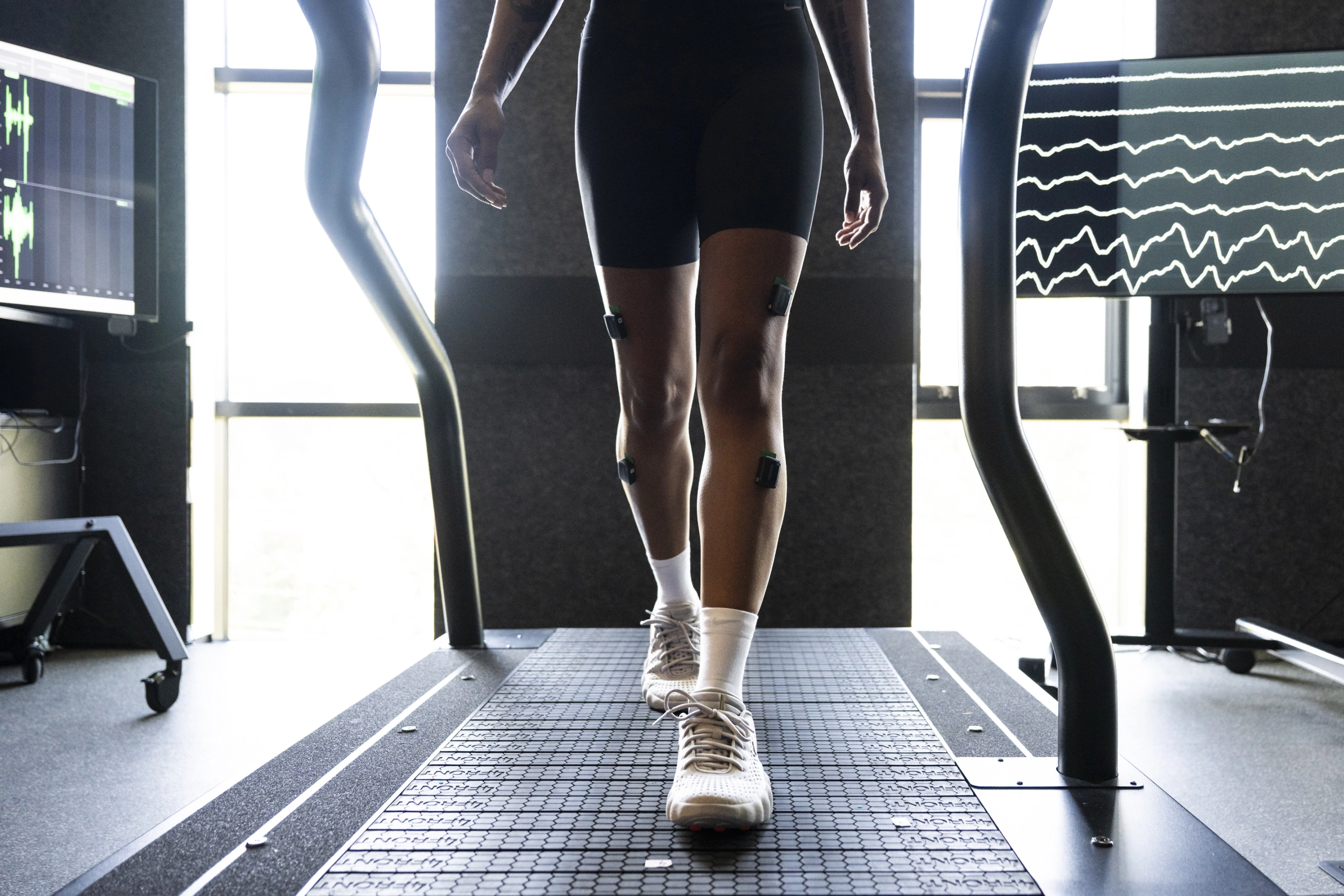
During testing, athletes walked in Nike Mind shoes while researchers monitored their brain activity. The results showed clear differences in brain activation and oscillation patterns.
“When we tested the first prototypes, we expected to see enhanced activation of the SMN,” says Moffat. “And there it was: a boost in the sensorimotor rhythm. That’s the activation that we expect to tune down the DMN.”
This change in brain rhythms is a sign you’re moving your attention away from those negative feedback loops. In other words, says Moffat, they indicate you’re turning off the swirl in your head, and instead, turning on a kind of relaxed alertness. You’re better connecting your mind and your body.
"One of the easiest ways to get out of your head is to bring your attention back to the present moment. You can achieve this by focusing on your body and on your sensations of the world around you."
Graeme Moffat, PhD. Principal Researcher, Mind Science Team
The beautiful part about it? You don’t need complicated gadgetry or machines to bring about this harmony. It’s simply the connection between the athlete, their shoe, and what their body senses under their feet.
“Nike Mind opens the door to a whole new category of sensory-optimized footwear,” Moffat says. “A lot of athletic shoes act as filters that reduce sensation. Nike Mind is designed for sensation first. We’re trying to help you really engage with new sensory experiences, focus on your intention, and get out of your head.”