How Andreas Almgren Unlocks Champion Results
- November 20, 2026
- Words:
Champions, especially new ones, are often complex creatures. Such is the case with the newly minted New York City Marathon winner, Andreas Almgren. Now a major player in the road running world, winning his debut races in both the half and full marathon, the Swede’s 2026 success is particularly captivating because it’s full of contradictions.
For example, Almgren broke through as an 800-meter runner early in his career but now excels at the marathon. He is disciplined and analytical — what you’d expect from someone with a master’s degree in mathematics — but also boisterous, often the catalyst for laughter in a room. He creates Excel spreadsheets to optimize his own training plans, but speaking with him reveals that his success is more likely a result of his ability to master the unquantifiable parts of running, the mentality and body feel.
Perhaps most fascinating, the self-coached Almgren is a decorated professional, holding the European record in the 10K, but his relationship with the sport is first and foremost centered around joy — not winning or time. Like so many runners, he was convinced to make a marathon debut after jealously spectating last year’s New York race. (Of course, a key difference is that he would go on to finish roughly two and half hours faster than the average runner.)
These contradictions are not a coincidence. They’re the result of natural curiosity, a reaction to years of injuries, and an ambition to win derived from viewing running as a gift. Here, he shares in his own words how he became the person and runner he is today, and what’s helped him become the champion he always knew he could be.
New York is an incredible race. I’m getting goosebumps just thinking about it. In my off-season in 2025, I was in New York cheering for my friend who ran the marathon. As a spectator, I was able to experience the atmosphere and the buzz in the city, and I knew that I had to be a part of it. I literally texted my agent the night after the race to tell him I was going to do it. When I finally made it to the starting line, I wasn’t even nervous. I was just so excited to be running in such an iconic race.
There’s something so special, mythical about the marathon. I’ve recently transitioned into road racing, and the events feel more like a party compared to track. The track is a repetitive loop, and there isn’t as much you can do to gain an edge during a race; that’s what makes the results so impressive. But during the marathon, there are hills, bridges and straights that create more opportunities to run a race that is unique.
It also felt natural to do the marathon because every time I moved to a longer race, I found success. I noticed that my body responded very well to high mileage, and I already had the speed from track, so I was confident in what I could do on the road. It still felt like I didn’t know what to expect while competing in it for the first time, but my training made me confident.
“I love thinking about my training. When I’m struggling, it’s a sort of therapy for me.”
Andreas Almgren, endurance runner and New York City Marathon champion
Apex is the greatest racing shoe I’ve ever worn. I first tried it in April but got a lot closer to it when I was adding mileage before New York. The softness and cushioning felt like it was saving my body during the marathon. In the last 5K of the race, when I was ready to speed up, it was able to give me the pop that almost feels like it’s pushing you forward.
I’ve experienced a lot of frustrating injuries in the past, so recovering and winning now means a lot. It also gives me comfort that I have built a blueprint for how to train and how to listen to myself. I think I’ve changed my approach so much, and I believe it did take multiple stress fractures for me to understand that there is more value to be gained in being in tune with my body than in making sure I hit each workout exactly the way it looks on paper.
I love thinking about my training. When I’m struggling, it’s a sort of therapy for me. To capture all my ideas, I use an Excel spreadsheet, where I can organize my lactate threshold, VO2 max and other metrics that can be combined with specific workouts to make me confident about achieving certain results. I think it’s good for every athlete to try to develop and be engaged in the training planning because ultimately, you know your body the best. I also think my injuries have played a part; I want to trust the plan that I’m using because I know it was made for me, by me.
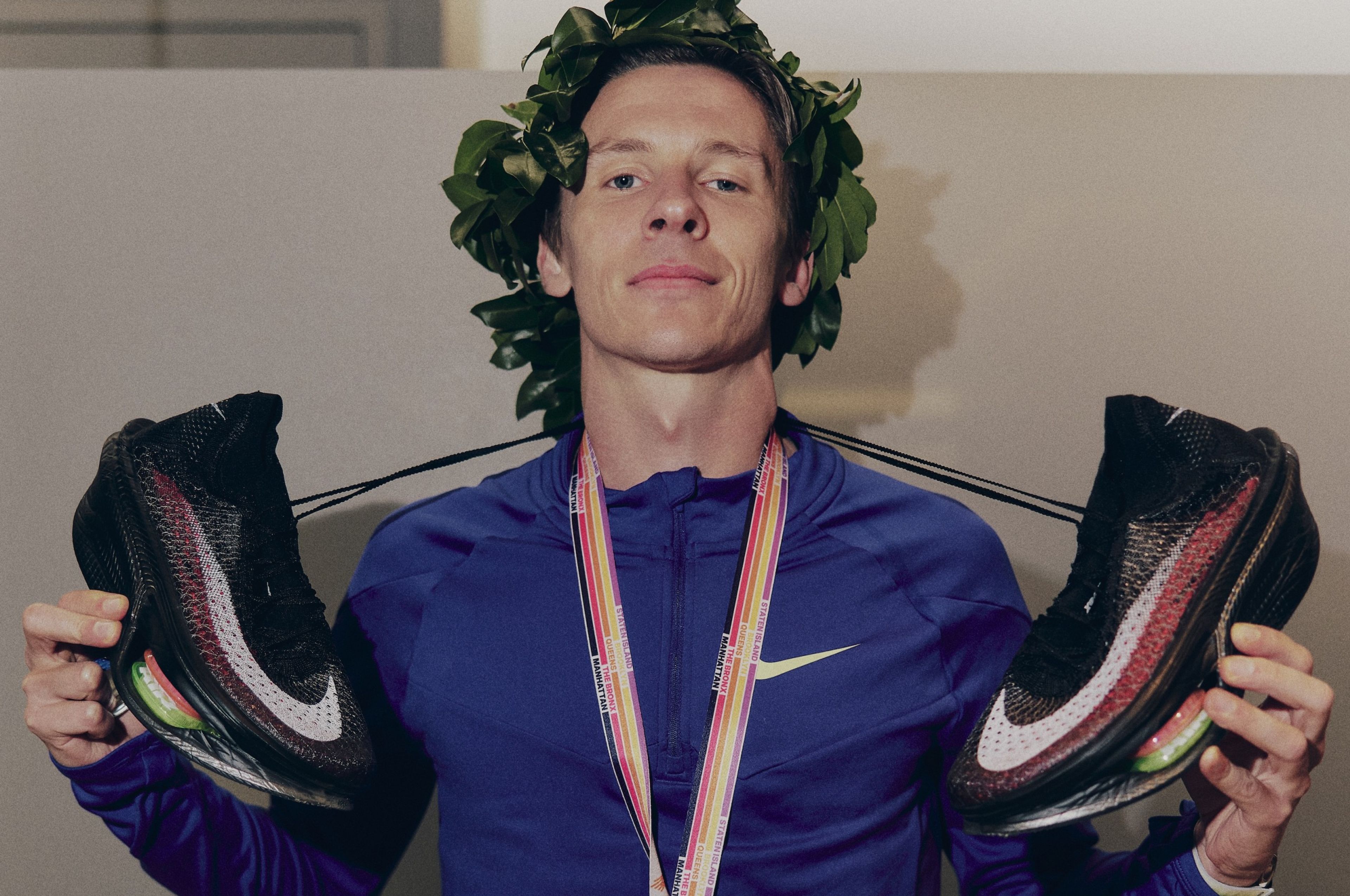
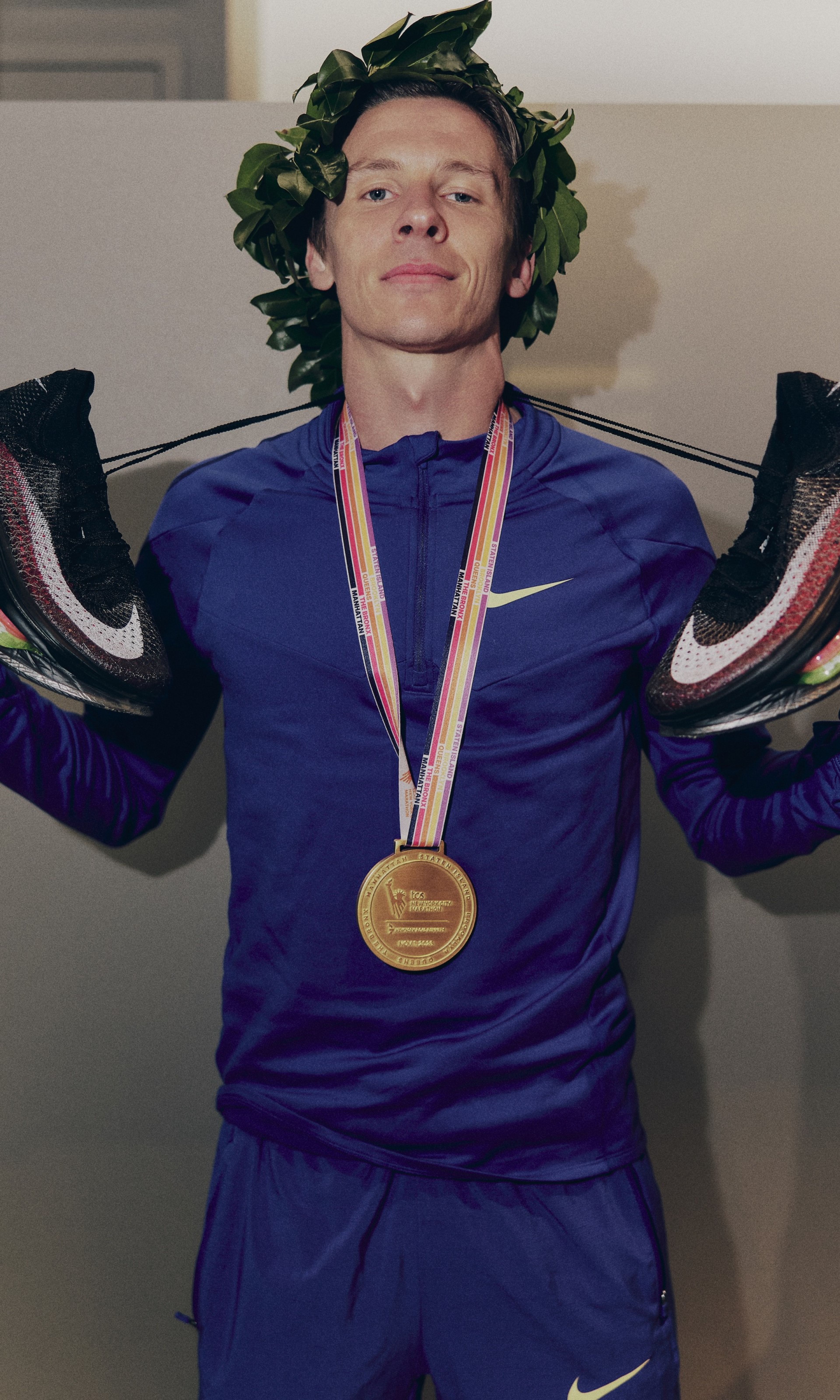
“I just felt so close to the shoes after winning that I didn’t want to take them off, so I just started wearing them around my neck after the race.”
Being a part of the Nike family is a big deal for me — it’s a bigger advantage than people think. Not only do you have access to the best technology, but you have access to the best athletes and advice in the world. Before the New York City Marathon, I spoke with Eliud Kipchoge, and he told me, “Run for yourself, run for your family, run for your friends, run for your nation, run for your continent and run for the Swoosh.” That just shows you how much pride each of us take in being a part of Nike.
I tend to have unique problems, and I look to Nike to create solutions for me. I use heat training to prepare for events, running on a treadmill in a climate chamber that is set at around 38 degrees Celsius [100 degrees Fahrenheit] and 60 percent humidity. This, of course, makes me sweat a lot, which means I can slip off the treadmill. So I asked Nike if they could design a shoe with a specific outsole to fix the issue — and they did! Just for me, and fast.
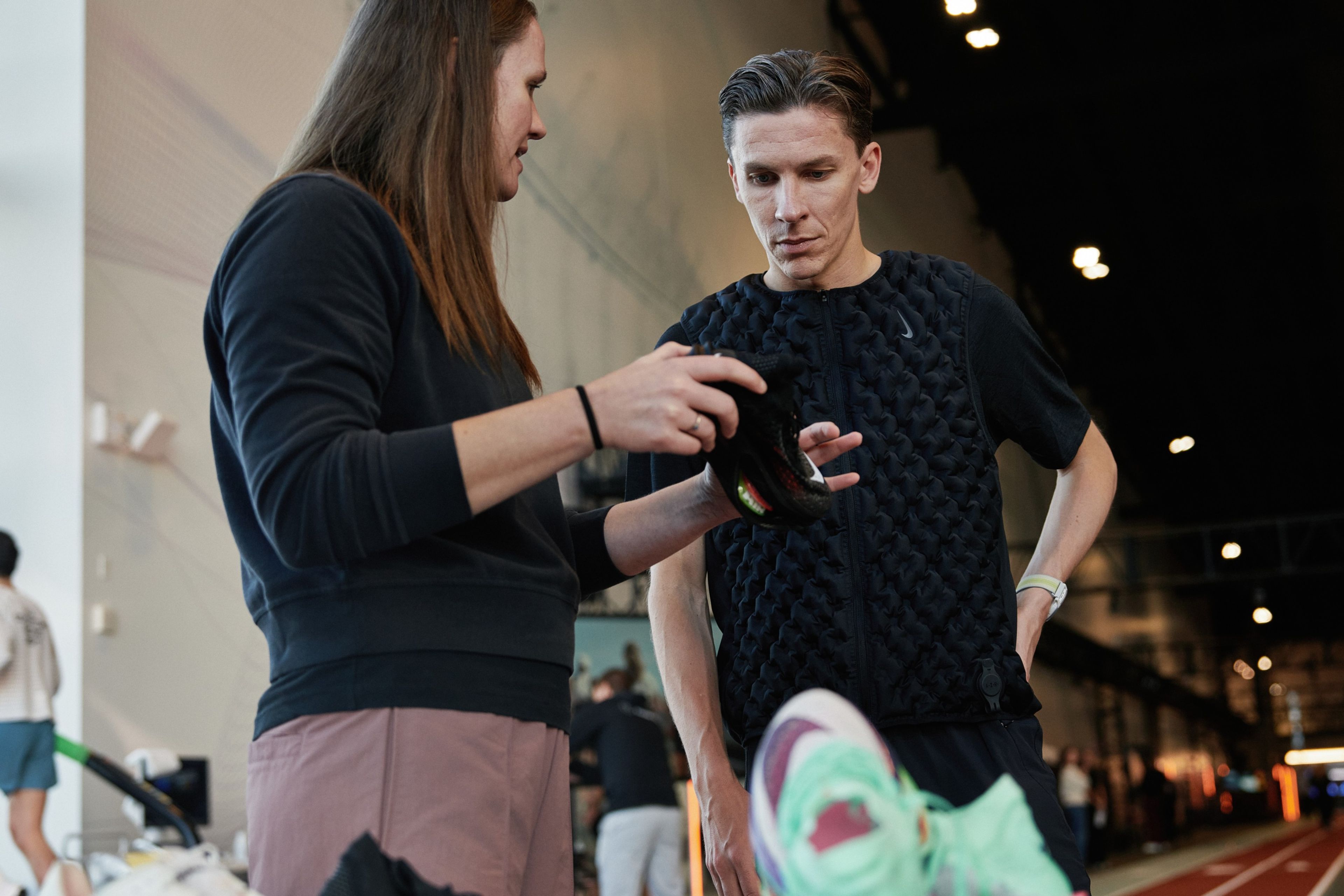
Andreas Almgren gives feedback to Nike researcher Emily Farina at the Nike Sport Research Lab.
“I want to help create great shoes. I think a lot about running, and I am constantly trying to optimize what can be done within the sport, so I love being with the Nike engineers who love doing the same thing.”
Andreas Almgren
It’s exciting to be a part of a great group of endurance athletes that have recently come up from Norway and Sweden. Seeing what athletes like Jakob Ingebrigtsen and his brothers have done, it changes your mindset; it makes you more willing to go the extra mile because you see people showing it’s possible. Maybe it’s something about being Nordics; you learn to be very hardworking. It’s how I was brought up. Work hard, and you get results. That part always made sense to me.
To compete and bring pride to Sweden is something that makes me very emotional. I grew up watching what we call “the golden era of Swedish track and field.” My first Olympic memory was when that group won three gold medals in 2004, and I felt this incredible pride hearing our anthem played. When I won gold at the European Championships, I will never forget the feeling of knowing I was the reason the anthem was playing. After New York, they didn’t play the anthem, but I did hear them play a Swedish house song, and that still made me feel pride.
I want to help create great shoes. I think a lot about running, and I am constantly trying to optimize what can be done within the sport, so I love being with the Nike engineers who love doing the same thing. It’s a privilege to give feedback that helps make better shoes for all runners, not just me.
It’s nice to be talked about since winning in New York. But after the initial celebrations, I made it clear I wanted to go back to Sweden and enjoy as much of this moment with the people who supported me before it happened. My family and friends are who ground me — they give me energy to keep going.