Welcome to the Most High-Tech Space in Football: The NSRL Pitch
- May 25, 2026
This game is beautiful, and even more so when it’s broken down into its fundamental parts. The Nike Sport Research Lab (NSRL) Football Pitch is where scientists take the game into the future.
What it is
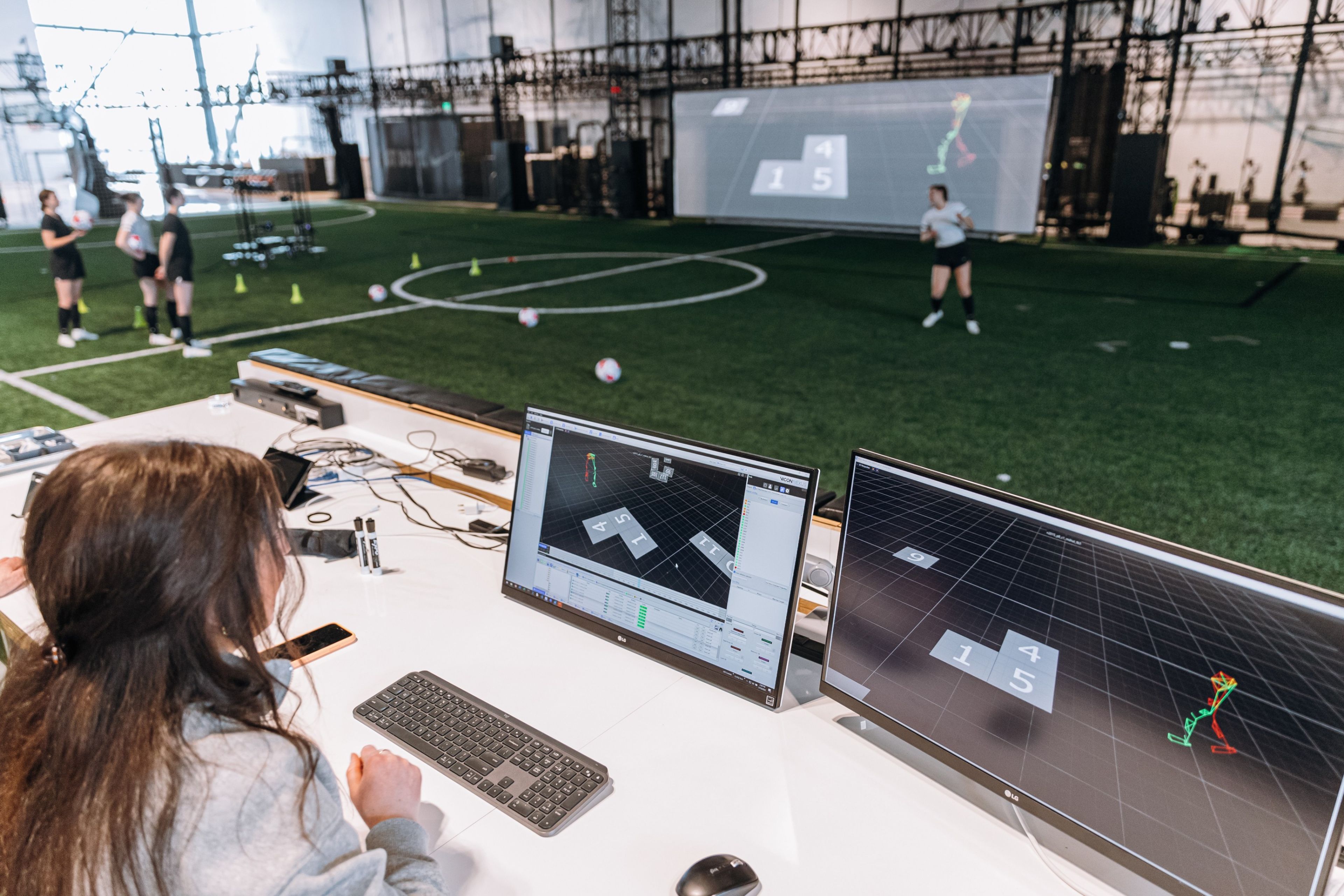
Under the crossbar, a soccer ball soars to the back of the net. The footballer who kicked it is covered in reflective motion capture markers across their lower body. A group of biomechanics researchers stand nearby, collecting data from their command center. With the motion capture system, the researchers are measuring the velocity of the player’s kick, the force they’re exerting into the ground, and the exact coordinates of where the ball lands inside the goal.
This pitch is inside the NSRL, a worldclass sport science facility on the 4th floor of the LeBron James Innovation Center. At 8,600 square feet, the pitch is one of the most advanced football spaces in the sport. The artificial turf surface, used in many professional stadiums, is embedded with force plates. Motion capture cameras strung across rigging, timing gates that are set underneath different zones of the pitch, high-speed video, and shot tracking are all tools used by the research team. Together, they allow researchers to better understand what footballers need to help them perform.
What it helps us do
Those who love football will tell you it’s unlike any other game in the world. Joe Helseth, NSRL Principal Researcher, says that feeling holds true even when the sport is put through a biomechanical filter.
Football is an extremely complex and fluid game, he says. The physical demands on the player are immense. Throughout a match there are rapid changes of direction, bursts of accelerations and decelerations, and sustained periods of moderate intensity movements. Players also must be able to manipulate and strike the ball with power and precision. Products need to be designed to meet those various demands of the game.
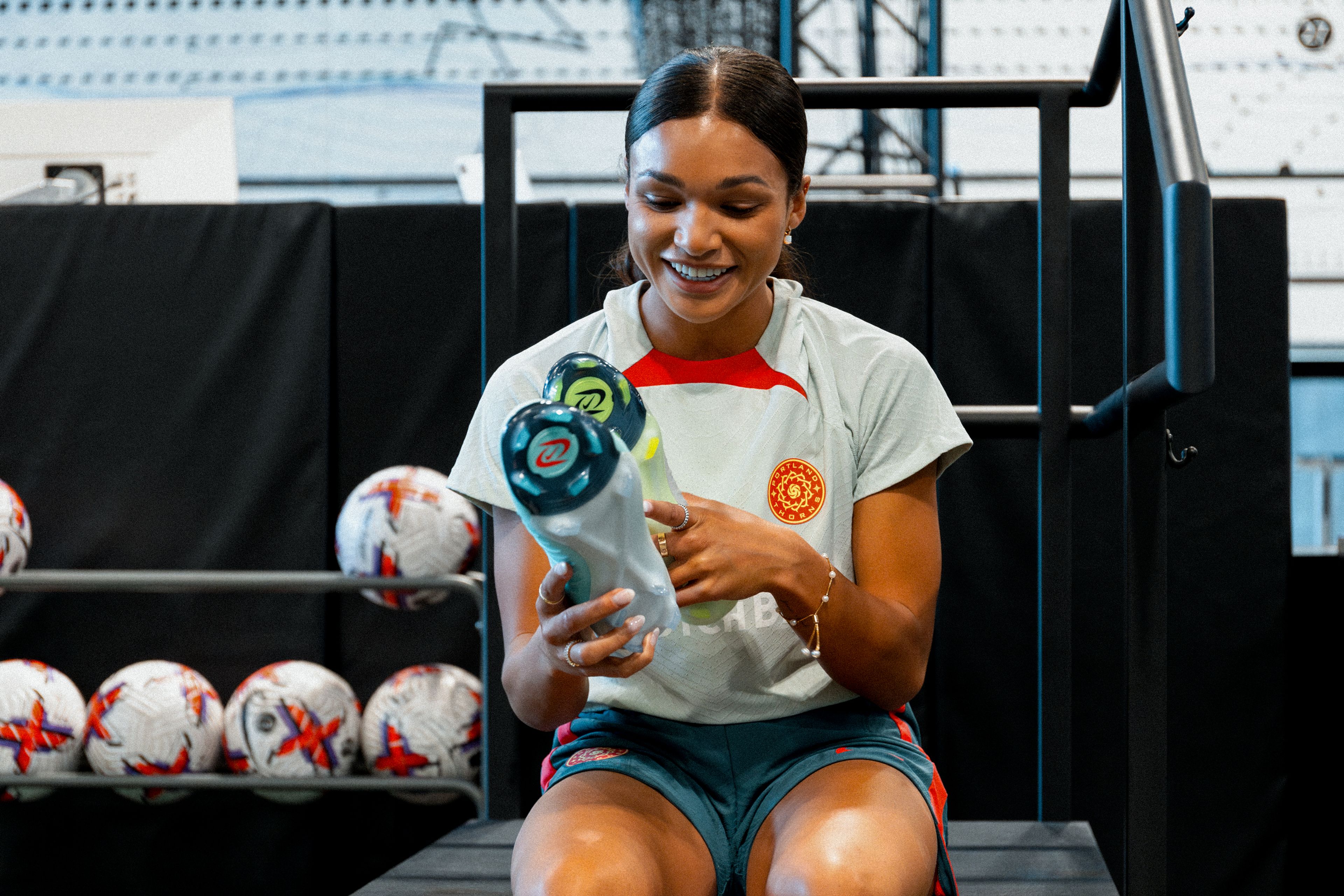
Tested and validated on the NSRL pitch, the traction pattern of 2023's Phantom Luna boot was designed to a circular cleat pattern that reduces the rotational traction between the boot and the surface.
That’s why the NSRL has audacious goals that are meant to take the game’s players into the future. For example, the Phantom Luna boot, released in 2023, was the result of years of research on the NSRL pitch which helped Nike scientists and engineers create Cyclone 360, a circular cleat pattern designed to reduce the rotational traction between the boot and the surface, which is believed to be related to the risk of knee injuries. This study of traction has its roots in the lab, but it has since reverberated outside the walls of the NSRL and into Nike’s bigger commitment to help players stay in the game. In April, Nike’s New York City Headquarters hosted the launch event of Project ACL, a joint 3-year research study between Nike, FIFPRO, Leeds Beckett University and the NWSL, with a goal to better understand how to reduce ACL tears among female footballers.
Moving this grade of research forward starts and ends with the boot. Understanding how a football boot performs largely comes down to three qualities: fit (comfort), ride (underfoot technology) and traction. The cutting-edge tools on the NSRL pitch allow researchers to break down these variables. For example, force plates can reveal the amount of force a player is putting into the ground while sharply cutting, providing insight into how players use the available traction provided by a new stud orientation. Timing gates, combined with motion capture during an agility drill, clock how a player sprints through zones, and exactly where they may be gaining or losing ground.
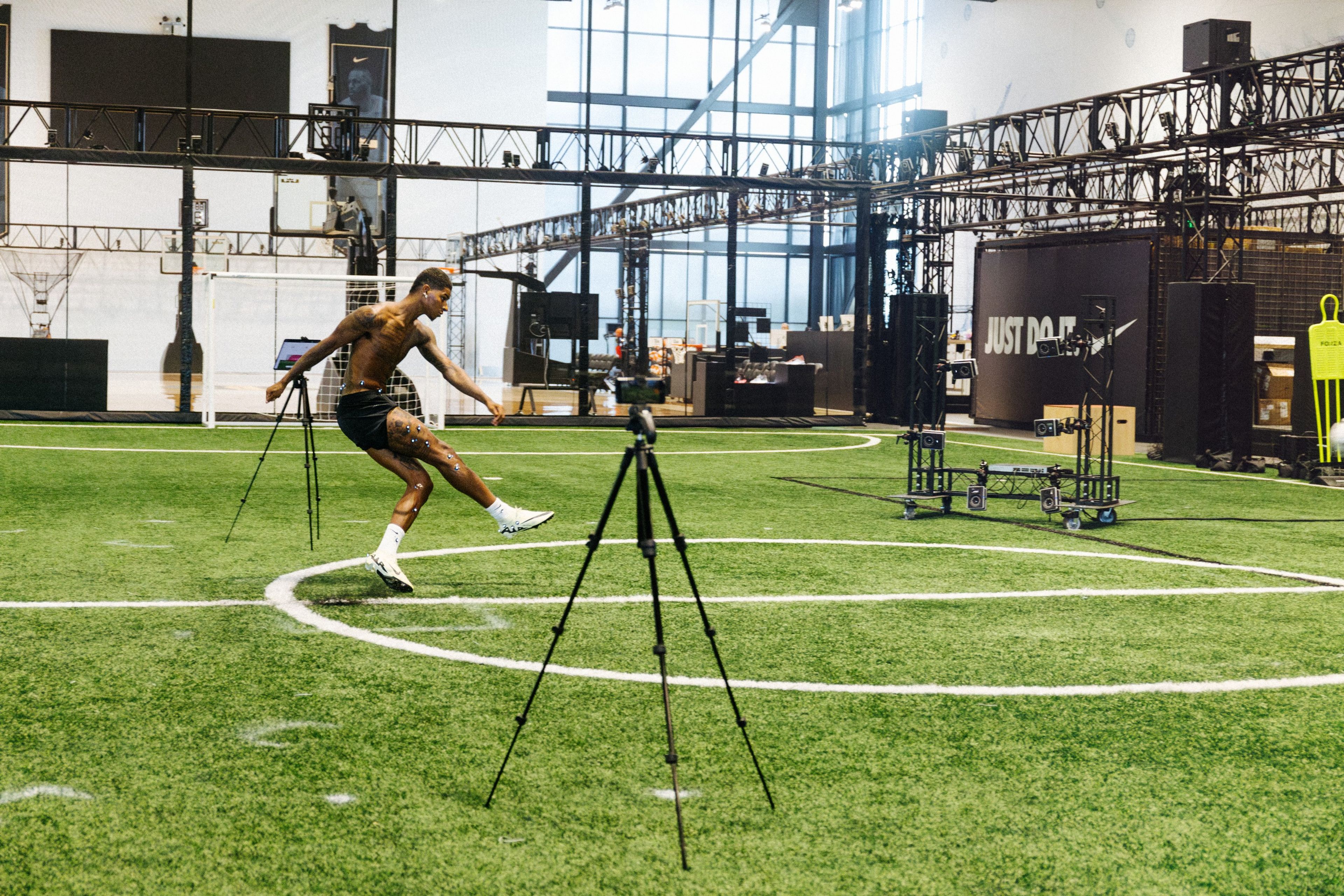
FC Barcelona forward Marcus Rashford tests a Mercurial prototype in the NSRL. Nearly every aspect of the boot’s performance can be studied, quantified and evaluated.
"Our research process is an important component of how we develop boots...That allows us to make systems that take human performance somewhere new."
Joe Helseth, NSRL Principal Researcher
This year’s Mercurial Superfly, seen on pitch during this summer’s tournament, was tested in the lab to harness the full power of Zoom Air for the footballer (2022 marked the first time that football-specific Zoom Air appeared in a Mercurial). Incorporating Zoom Air into a boot can’t just be done on a whim; the team studied the right shape, placement and volume to act on the athlete during push-off. How can Zoom Air work harmoniously with the sport’s movements and the variety of playing surfaces so players can hit their top-end speed?
Throughout the innovation process, designers and developers worked with researchers in the NSRL to evaluate the functionality of various Mercurial prototypes. Researchers examined how different Zoom Air units influence the way players move on the pitch. This can be studied through tests that measure metabolic power, sprinting performance, and lower extremity biomechanics using those precise tools on, above and surrounding the pitch. After years of prototyping, the Mercurial Superfly coming to the pitch for this summer’s tournament landed on an 8mm bag, tuned to provide energy return to a player at the moment they need it most. It helps give the feeling of kickback that players need at a full sprint.
“Ultimately, the boot is a tool for footballers to wield,” says Helseth. “Our research process is an important component of how we develop boots. “Utilizing the data we can capture and the expertise of our researchers, we can guide development through an objective lens. That allows us to make systems that take human performance somewhere new.”