The LeBron James Basketball Court
- February 12, 2026
- Contributing Photographer
Basketball is a nuanced game of human movement. At the LeBron James Basketball Court, Nike scientists use an advanced blend of methods to study it.
What It Is
The LeBron James Basketball Court is a FIBA regulation-size basketball court housed in the Nike Sport Research Lab (NSRL), on the fourth floor of the LeBron James Innovation Center. Every aspect of the building is enormous in scope, and the capabilities of his basketball court, located in a lab that has more than 80,000 square feet of data-collection space, is no exception. Nestled inside the largest sport-focused force plate and motion-capture installation in the world, the LeBron James Basketball Court sets the gold standard for gathering basketball data.
Underneath the hardwood sit 11 force plates arranged at key spots on the floor, like around the three-point line and inside the key. The plates measure an incredible volume of data, at a frequency of 2,500 contact force data points a second. The plates are so sensitive that they can pick up an athlete’s heartbeat. All of the force plates are mounted on a subfloor disconnected from the surrounding floor so that they do not pick up footfalls from across the court.
With the court, scientists can observe from the ground up how athletes interact with footwear. Using a special version of the ground reaction force plate with a translucent window flush with the hardwood, scientists shine a special LED light through the surface of the window, allowing them to observe on camera how a shoe’s traction pattern responds during certain movements. Scientists can also translate the high-res video through light-intensity imaging software to quantify areas of highest contact on a shoe’s outsole; this can influence design details, like the traction pattern itself, the rubber compound and even the midsole composition.
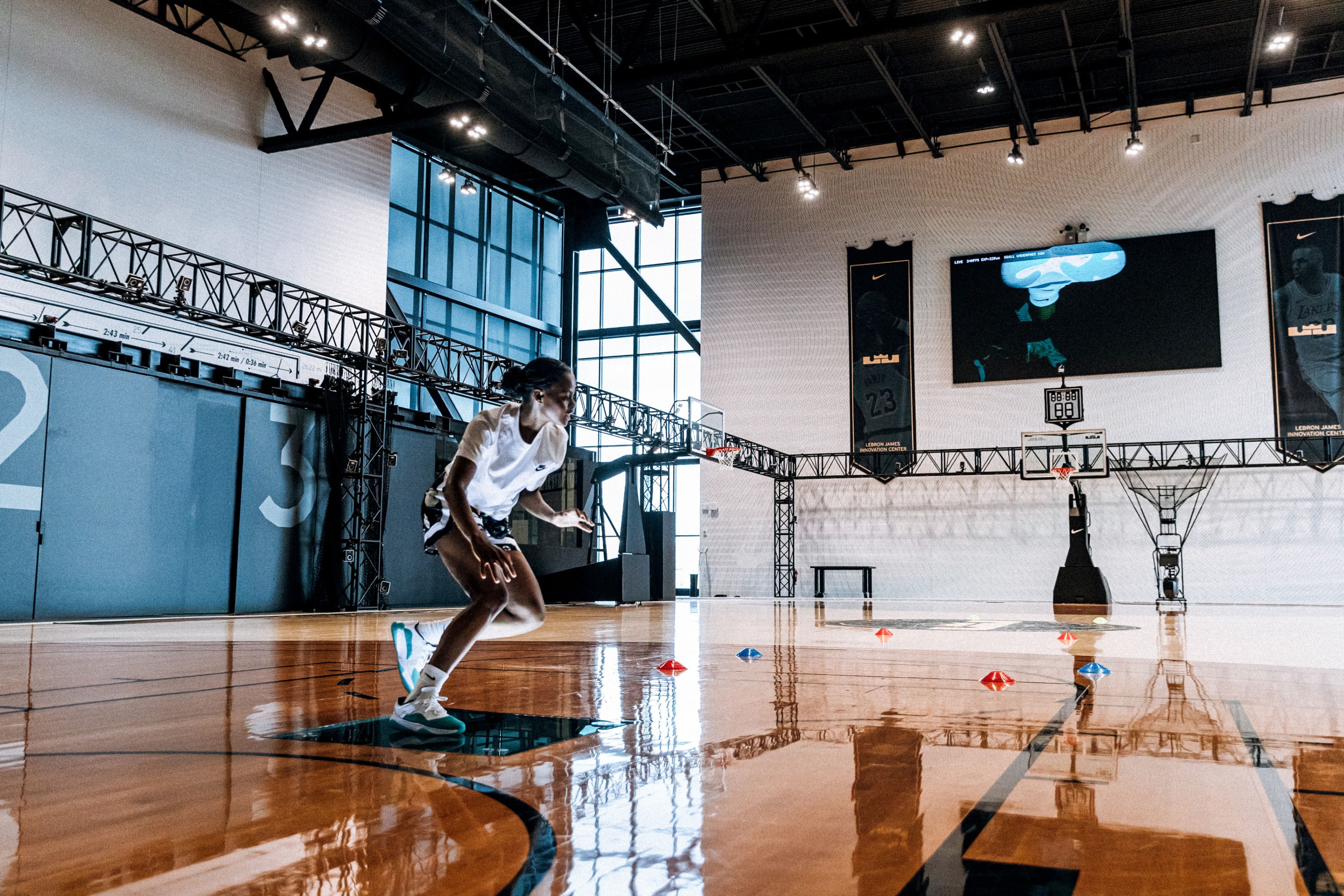
On the court, Nike scientists study how product uniquely influences a player’s movement.
No other basketball court has the same motion-capture capabilities as this one. Researchers fit athletes with markers across their bodies to enable high-fidelity capture of minute changes in athlete movements, interpreted through advanced software. High-speed video from the many cameras suspended by the court’s outer rigging can break down the ways a player dribbles, pivots, sprints and slides. Meanwhile, physiological data, like a player’s oxygen consumption and heart rate, can be recorded in real time through wearable devices.
What It Helps Us Do
If a basketball product is to be measured objectively, it should be done by how it influences a player’s movement. No surprise, this is best seen in a real, unrestricted game. Last winter, the lab concluded its first season of the NSRL Basketball League, a women’s evening tournament featuring four squads with teammates recruited from both inside and outside of Nike. All players competed either collegiately or professionally. The games are a full four quarters, on a full court, with a team of referees. The rules are as core as you’d expect from any basketball scrimmage. What’s different about this league is how the NSRL’s tools are seamlessly integrated into the gameplay. For example, motion software depicts the common paths that players take by position, from a perimeter-oriented guard to a big who protects the paint. It’s through tools like these that scientists can measure whether a player is moving with more speed or agility based on the shoes they are wearing. Heart rate monitors can help researchers understand whether a shoe can mitigate fatigue throughout a game.
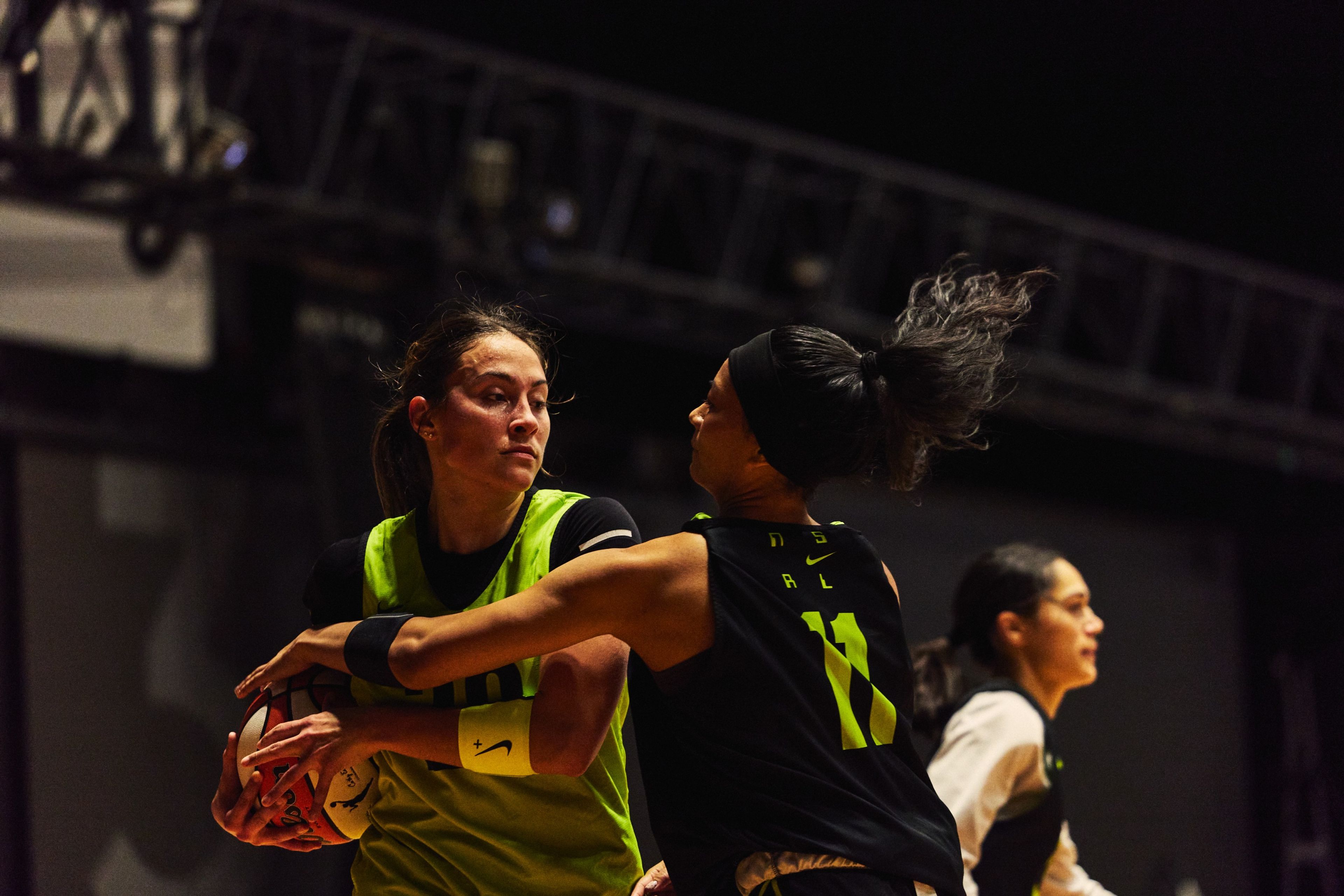
The most accurate research comes from the most authentic playing environments. The inaugural NSRL Basketball League put players in unrestricted, in-game settings, yielding important product feedback.
The ingenuity of the league stems from a challenge inherent to the sport: Basketball movement is complicated. Its style is not as linear as other sports. Basketball is like jazz, filled with unexpected changes of direction, speed and rhythm. A research setting for basketball has to include enough features to allow players to cut loose, break outside of a contrived environment, and play as they would naturally, in addition to controlled protocols that break down all the variables of the complex sport. That’s why the LeBron James Basketball Court, as a research facility, is as nuanced as the sport itself.